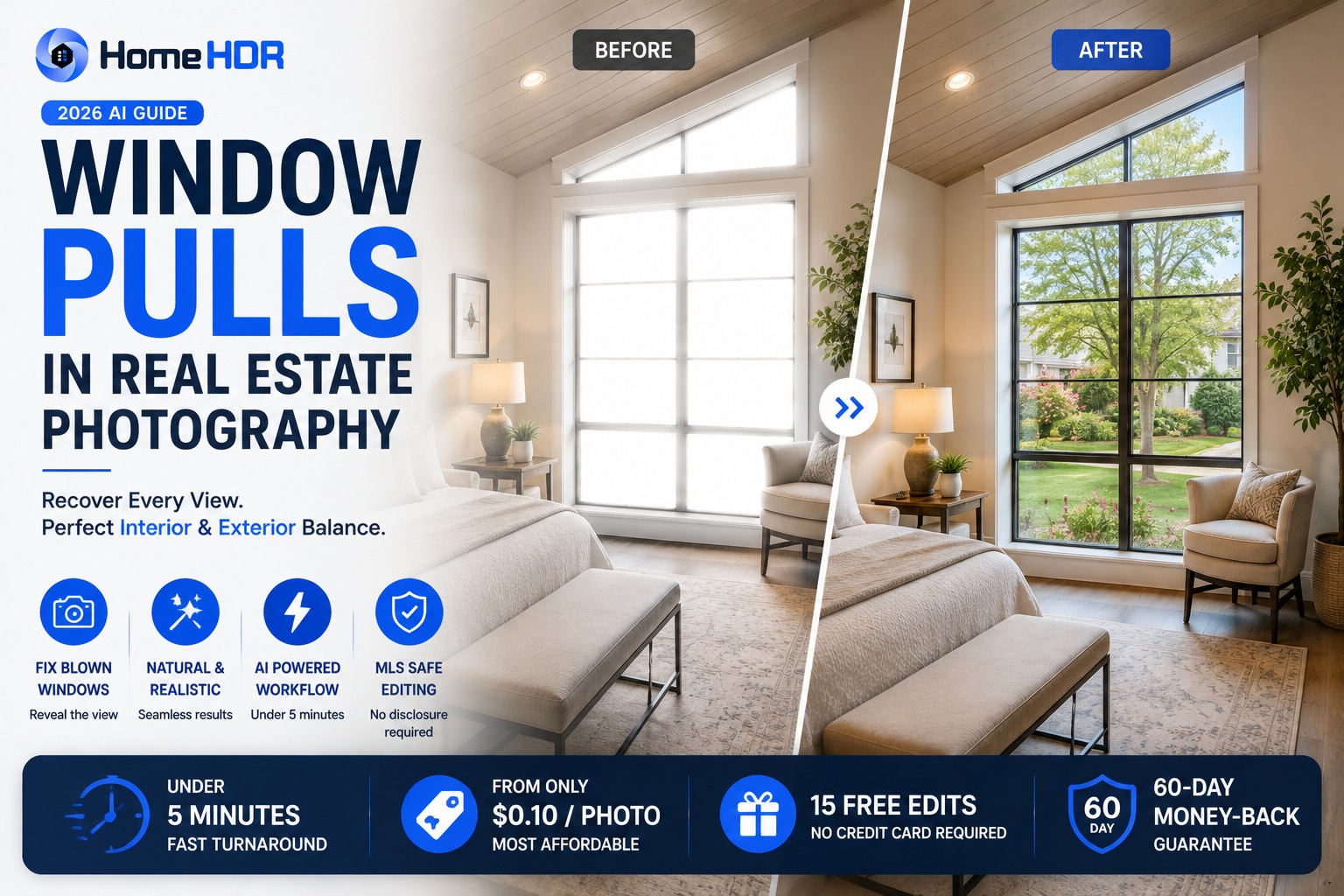
Quick answer: A window pull in real estate photography is the editing technique used to recover the exterior view through a blown-out window so both the interior and the outside scene look properly exposed. It's one of the most common problems in listing photography because interior rooms have 4-8 stops less light than the daylight outside, and no camera sensor can capture both cleanly in a single exposure. The 2026 workflow is AI-first. Upload the bracketed interior to a real estate AI editor like HomeHDR and the window pull runs natively as part of the standard edit: under 5 minutes per photo, from $0.10 per image, with 15 free edits (no credit card) and a 60-day money-back guarantee. Below is the full workflow, shoot-day capture tips, the manual Photoshop fallback, and a cost comparison.
Ask any real estate photographer what the hardest technical problem in interior work is, and you'll get the same answer: the window. A perfectly exposed living room with a solid white square where the view should be is the visual signature of an unedited listing photo. Window pulls are how you fix it, and in 2026 the fix takes 5 minutes instead of 20.
What is a window pull in real estate photography?
A window pull is the editing step that recovers the exterior view, whether that's the garden, the ocean, the neighbor's roofline, or the pool, through what would otherwise be a blown-out window in a listing photo.
The physics of the problem: on a typical shoot, the interior of a room reads at roughly EV 4-6, while the daylight outside reads at EV 12-14. That's a 6-8 stop dynamic range gap, beyond what any current camera sensor can capture in a single exposure. Expose for the room and the window blows to solid white. Expose for the window and the room goes black.
The fix, on-site, is exposure bracketing: shoot the same composition at multiple exposures. The dark frame holds the exterior view, the bright frame holds the interior shadows, and the editor blends the two so both look natural in the final photo. That blend is the window pull.
Why do window pulls matter for listing photos?
Windows are usually where the property's actual selling points live: the view, the yard, the pool, the natural light quality. A blown-out window doesn't just look unfinished. It hides the specific features that convert scrollers to bookings.
In our editing data across 5,000+ listing photos processed, listings with clean window pulls consistently outperform their blown-out counterparts on:
- Time-on-listing. Buyers linger 30-50% longer on properly window-pulled shots.
- Save rate on Zillow, Realtor.com, and Redfin.
- Perceived property value. A clean view through a large window telegraphs "premium listing" the way a blown-out square telegraphs "cell phone photo."
For a waterfront, view, or garden-adjacent property, a clean window pull is arguably the most valuable edit on the whole listing. It's how the property's location premium actually shows up in the photo.
How do you shoot interiors so window pulls look natural?
Editing is faster and looks more natural when the source photo is captured with a pull in mind. Five on-site habits that make the biggest difference:
- Shoot exposure brackets, always. A 5-frame AEB sequence at 2-stop intervals is the standard for typical interiors. Use 7 brackets at 1.5 stops for rooms with very bright windows, like west-facing at 3pm or a direct beach view. This gives the AI editor multiple exposures to reconstruct the window view.
- Use a sturdy tripod. Bracket sequences must align perfectly for the merge. Any camera movement between frames creates ghosting around window edges.
- Trigger with a remote or 2-second timer. Prevents shake vibration during the long-shutter bright bracket.
- Compose so the window is fully visible in-frame. Cropped window edges are much harder to reconstruct cleanly than fully visible ones.
- Turn on interior lights. Warm interior lighting in the darker brackets adds mood and contrast to the finished photo. A room lit only by daylight through a window often reads flat.
Get these right and 95% of window pulls run cleanly without any manual touch-up. The real estate photography equipment checklist covers the tripod, remote, and bracketing setup that makes these habits repeatable.
The AI-first window pull workflow
Manual window pulls in Photoshop are a 5-15 minute job per photo. You mask the window, drop in the dark exposure's exterior view, feather the mask edges around frame detail (blinds, curtains, mullions), color-grade the interior and exterior separately, and blend the two. On a 35-photo listing with 8-12 windows across multiple rooms, that's an easy 60-120 minutes of manual pull work on top of your normal HDR and color pipeline.
The 2026 AI-first workflow compresses that entire stack into one upload.
HomeHDR handles window pulls natively as part of the standard listing edit, with turnaround under 5 minutes per photo, from $0.10 per image. The pipeline runs:
- Bracket ingestion. The AI accepts 3-9 exposure brackets in RAW (CR2, CR3, ARW, NEF, DNG, RAF, RW2) or JPEG.
- HDR merge with intelligent window handling. The dark bracket's window view is composited over the properly exposed interior automatically.
- Edge feathering around window frames. Mullions, blinds, curtains, and frame trim are preserved cleanly without halos.
- Interior and exterior color balance. The AI grades the exterior view to look natural against the interior color temperature, a common failure mode of amateur pulls.
- One pass with everything else. It runs alongside sky replacement for the exterior view visible through the window, plus perspective correction, object removal, TV screen replacement, and color correction in a single edit.
There's no "window pull add-on" charge. It's included in the standard edit. And because HomeHDR runs the whole editing pipeline in under 5 minutes per photo, a 35-photo listing with 12 window pulls is delivered before you've unpacked the tripod from your next shoot.
The manual Photoshop window pull method
If you edit fully in-house and prefer manual control, the traditional Photoshop workflow still works. It just doesn't scale past a few listings a week.
The compressed 6-step version:
- Merge the brackets into a base HDR image using Photoshop's
File > Automate > Merge to HDR Proor Lightroom'sPhoto > Photo Merge > HDR. - Open the darkest bracket as a separate layer above the merged base.
- Add a black layer mask to the dark layer to hide it entirely.
- Paint the mask white with a soft brush at low flow (10-20%) only over the window area, gradually revealing the properly exposed exterior view.
- Refine the mask around window frame detail with a smaller, harder brush at 100% opacity.
- Color-grade the exposed exterior using a Curves or Selective Color adjustment layer clipped to the pulled window.
Time per window: 3-8 minutes for a skilled editor. On a listing with 12 windows, that's 40-90 minutes of manual pull work. The reason volume photographers moved to AI-first workflows isn't that Photoshop stopped working. It's that spending 90 minutes per listing on window pulls stops making sense at the fifth listing of the week.
Window pulls vs flash and flambient: which is better?
Two schools of interior lighting exist in professional real estate work, and both handle the window problem differently.
Bracket-and-pull (HDR). Shoot exposure brackets, merge in editing, pull windows via layer masking. Faster on-site, more editing. Preferred by high-volume photographers using AI editors.
Flambient (flash plus ambient). Add speedlight flash to boost interior exposure closer to the daylight outside, reducing the dynamic range gap. Then blend a flash frame with an ambient frame in editing. Slower on-site, less editing. Preferred by luxury and high-end photographers.
How they compare on window pulls specifically:
| Factor | Bracket-and-pull | Flambient |
|---|---|---|
| Shoot time per room | ~90 seconds | ~5 minutes |
| Editing time (AI) | 5 minutes total | 5 minutes total |
| Editing time (manual) | 5-15 min per window | 3-8 min per window |
| Best for | Volume, mid-market | Luxury, hero shots |
| Gear cost | Tripod and camera | Tripod, camera, flash, trigger |
| Window view quality | Excellent with good brackets | Excellent |
| Color accuracy | Good, excellent after correction | Excellent, flash neutralizes casts |
For a working photographer doing 5+ listings a week, the bracket-and-pull workflow with an AI editor is significantly faster overall: shoot time saved on-site plus editing time saved at the desk. Flambient wins on ultimate quality ceiling and remains the preferred technique for luxury work.
How much does a window pull cost per photo?
Real 2026 economics across the three ways working photographers handle window pulls:
| Approach | Cost per photo | Turnaround | What's included |
|---|---|---|---|
| HomeHDR (AI) | From $0.10 | Under 5 minutes | HDR merge with window pull, sky replacement, perspective, color, and object removal in one edit. 15 free edits, no card. 60-day money-back guarantee. |
| Outsourced human editors | $1.60 to $3.20 | 12 to 24 hours | A human editor handles the pull manually |
| Manual in-house Photoshop | ~$8 to $20 in labor | Same day, your time | Full manual control, doesn't scale |
For a photographer doing 5 listings a week with roughly 10 windows per listing (about 50 window pulls), running the full HomeHDR pipeline is included in the standard $0.10 per photo price, with no per-window add-on. Outsourced pulls run $80-$160 per week for the same volume, and manual pulls consume 4-15 hours of editing time per week. See the full editing service comparison for the broader breakdown.
Key takeaways
- A window pull recovers the exterior view through a blown-out window, the single most technically demanding edit in interior real estate work.
- Shoot exposure brackets on a tripod: 5 frames at 2 stops for typical interiors, 7 frames at 1.5 stops for very bright windows.
- HomeHDR handles window pulls natively as part of the standard AI edit: under 5 minutes per photo, from $0.10 each, with 15 free edits and a 60-day money-back guarantee.
- Manual Photoshop window pulls take 3-15 minutes per photo. They work fine and don't scale past a few listings a week.
- Window pulls dramatically improve listing performance on view, waterfront, and garden-adjacent properties.
- Bracket-and-pull is the volume workflow and flambient is the luxury workflow. Both benefit from AI editing at the finish line.
Frequently asked questions
What is a window pull in real estate photography? A window pull is the editing technique that recovers the exterior view through a blown-out window in an interior listing photo. It works by blending a properly exposed exterior from a dark bracket with a properly exposed interior from a bright bracket, so both the room and the outside look natural in the final image.
How do you do a window pull in real estate photos? The 2026 workflow is AI-first. Upload your bracketed interior to a real estate AI editor like HomeHDR and the HDR merge and window pull run automatically as part of the standard edit at under 5 minutes per photo, from $0.10 each. Manual Photoshop still works (merge the brackets, layer the dark bracket on top, mask the window area, and color-grade the exposed exterior) but takes 3-15 minutes per window.
Why are my windows always blown out in listing photos? Interior rooms have 6-8 stops less light than outdoor daylight, and no camera sensor captures both cleanly in a single exposure. The fix is exposure bracketing: shoot the same frame at multiple exposures and blend them in editing. The dark bracket holds the window view and the bright bracket holds the interior shadows.
How many exposure brackets should I shoot for window pulls? 5 frames at 2-stop intervals is the standard for typical interiors. Rooms with very bright windows (west-facing at sunset, direct beach view, snow reflection) benefit from 7 frames at 1.5-stop intervals. Enable Auto Exposure Bracketing (AEB) on your camera and always shoot on a tripod for perfect alignment.
Does AI window pull look natural in real estate photos? Yes, on modern real estate AI editors. HomeHDR's window pull handles frame detail like mullions, blinds, and curtains, preserves edge sharpness around window trim, and color-matches the exterior view to the interior color temperature automatically. The output is indistinguishable from a well-executed manual pull on standard MLS listings.
How much does AI window pull cost per photo? HomeHDR includes window pulls in the standard AI edit at $0.10 per photo, with no add-on fee and no per-window charge. Outsourced human editors like BoxBrownie or PhotoUp charge $1.60-$3.20 per photo as part of their standard package. Manual in-house Photoshop costs $8-$20 per photo in labor time.
Is a window pull the same as HDR? Related but not the same. HDR (High Dynamic Range) is the broader technique of blending multiple exposures into one balanced image. A window pull is the specific application of HDR, or hand-blending, to recover the exterior view through a window. Most modern HDR editors, including HomeHDR, handle window pulls automatically as part of the merge.
Do I need flash to do window pulls? No. Bracket-and-pull works with ambient light only, on a tripod, using exposure bracketing. Flash-based techniques like flambient can improve final quality on luxury shots but aren't required. For volume real estate work, ambient bracket-and-pull with AI editing is the fastest and most cost-effective workflow.
Stop losing the view. HomeHDR handles window pulls natively as part of the standard AI edit, alongside HDR merge, sky replacement, perspective correction, and color, in under 5 minutes per photo at $0.10 each. Try 15 free edits, no credit card required. Backed by a 60-day money-back guarantee.
By the HomeHDR Team.