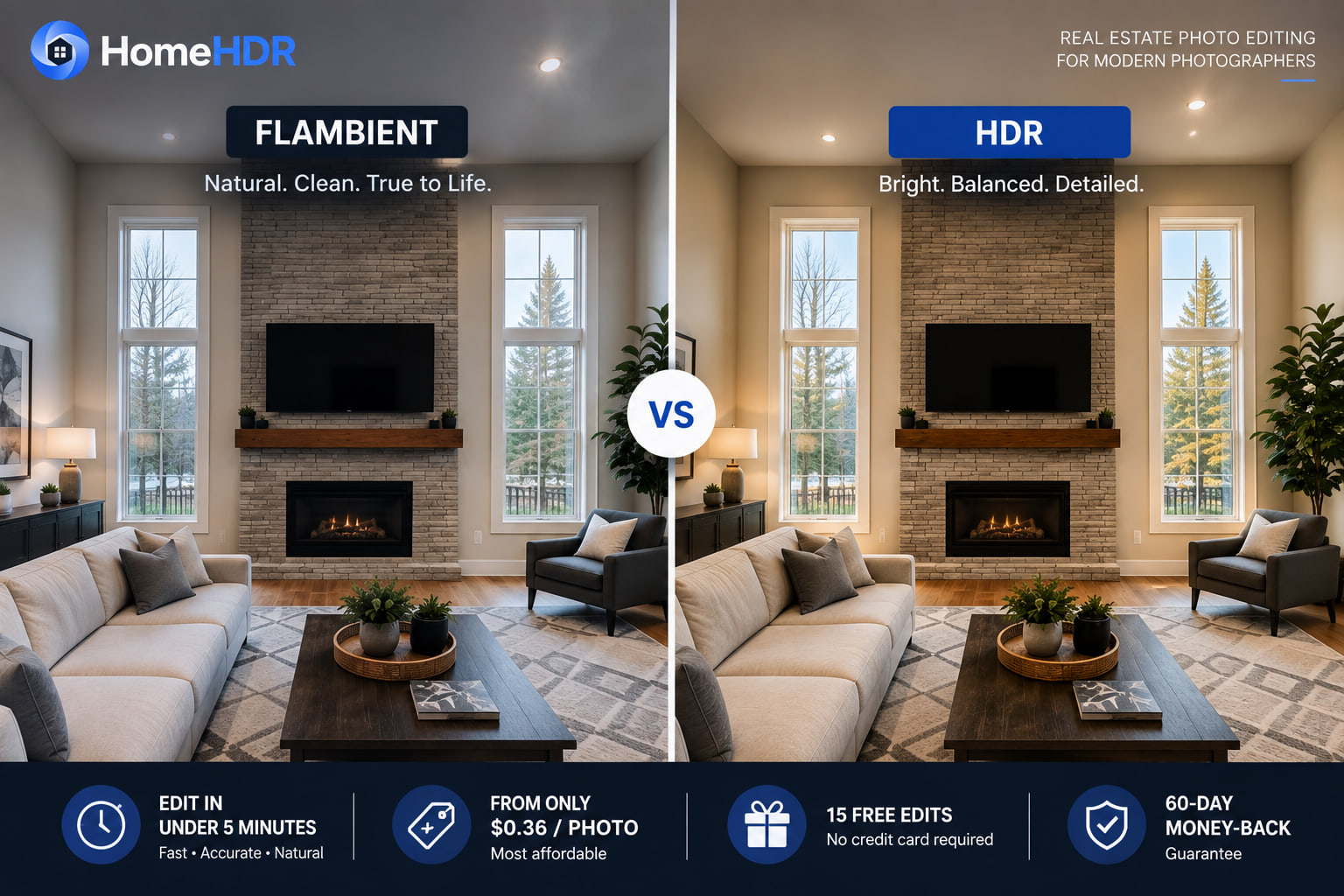
Quick answer: Flambient and HDR are the two main ways real estate photographers expose an interior. HDR blends 3 to 9 exposure brackets into one balanced image, fast on site and easy to batch. Flambient blends ambient (natural light) frames with flash frames for cleaner colour, more natural light, and it still owns the top of the luxury market. HDR wins on speed and volume. Flambient wins on the hero shots and the $2M listings where every window pull matters. Most working photographers in 2026 shoot HDR brackets on site, use AI editing (like HomeHDR, under 5 minutes, from $0.36 a photo, 15 free edits, no card) to handle the routine 80% of the gallery, and keep the flambient blend for the two or three shots that genuinely earn it.
You have had this debate. Probably with yourself, at 11pm, halfway through a listing. HDR brackets are already on the card, but that great room really deserves the flambient treatment, and you are already looking at three more hours in Photoshop before you can send the gallery.
This is not a question of which technique is better. Both can produce a beautiful, magazine-ready interior. The real question is where each one still earns its place in a 2026 workflow, and where the time cost has quietly stopped being worth it. What follows is the honest, peer to peer breakdown.
What is HDR real estate photography?
HDR (High Dynamic Range) real estate photography means shooting the same composition at several exposures, a dark frame, a normal frame, a bright frame, then merging those brackets into one image that holds detail in both the shadows and the highlights. It is the workhorse technique for most working photographers because it is fast to shoot, fast to edit, and reliable across a mixed portfolio of listings.
A typical mid-market interior gets 5 brackets, 2 stops apart. Rooms with bright windows often need 7 brackets at 1.5 stops to protect the exterior view from clipping, a classic window pull scenario.
Strengths: single tripod position, fire the bracket sequence, move on. No flash to haul or trigger, no assistant required, and it batches cleanly in Lightroom or a dedicated HDR merge tool. On volume days, three listings back to back, HDR is the only technique that actually keeps you on schedule.
Where it drifts: under mixed lighting (tungsten kitchen, daylight window, LED cabinet strip) colour accuracy can shift room to room, and heavy-handed tone mapping in post can leave a room looking a little too processed for buyer taste. Both are editing-side problems, not shooting-side problems. The source brackets are almost always fine.
What is flambient photography?
Flambient is a portmanteau of flash and ambient. You shoot the room twice: once lit only by natural or ambient light, and once (or several times) with flash, usually a speedlight bounced off a ceiling or wall. In editing you blend the two. The ambient frames hold the warm, realistic mood and the window view, and the flash frames deliver clean, neutral colour and even light into every corner.
Strengths: the most natural, true to life result, with accurate whites, no colour casts from mixed light sources, and soft even illumination in shadow areas. It is the technique behind most high-end and luxury listing photography, and there is a reason for that. On the hero shot of a $3M great room, nothing else looks quite the same.
What it asks of you: more frames on site (ambient plus one or two flash pops per direction), a flash setup to carry and trigger, and, the honest part, manual layer and mask work in Photoshop, often 10 to 20 minutes per photo for a skilled editor. On a 30-photo gallery that is five to ten hours of screen time. That is the whole tradeoff in one sentence.
Flambient vs HDR: what actually differs?
Both techniques can produce a professional final image. The real difference shows up in the workflow, not the pixel.
| Factor | HDR | Flambient |
|---|---|---|
| What you blend | Exposure brackets only | Ambient frames plus flash frames |
| Gear on site | Camera and tripod | Camera, tripod and flash (often 2 or more) |
| Time on site | Fastest | 30% to 50% longer per room |
| Colour accuracy | Good, drifts under mixed light | Excellent |
| Light quality | Natural but uneven in corners | Clean, even, professional |
| Editing time per photo | 1 to 3 min (batched) | 10 to 20 min (manual masking) |
| Best for | Volume days, mid-market listings, agent-driven shoots | Luxury, hero shots, brand-defining work |
| Learning curve | Moderate on shoot, easy in edit | Moderate on shoot, steep in edit |
| Where the cost sits | Almost none | Editing hours |
The gear list is not the interesting part. The interesting part is the last row: flambient's quality advantage sits inside your editing hours.
Which technique should you use in 2026?
It comes down to what you are optimising for, and this is where most photographers already have a feel for the answer. They just have not said it out loud.
- Optimising for volume and turnaround? HDR. If you are running 2 to 4 listings a day and the agent wants photos by 8am, the on-site speed and easy edit are non-negotiable. This is the majority of the market.
- Optimising for top-tier quality on a specific listing? Flambient. When the property, and your reputation on it, depends on flawless light and colour, the extra effort pays back in referrals. This is a smaller share of your calendar but often a bigger share of your best portfolio work.
- Most working photographers? A hybrid. Shoot HDR brackets for the bulk of the gallery, and shoot flambient (or at least ambient plus flash) on the 2 or 3 hero shots: kitchen, primary suite, main living space. This is where the industry has been quietly moving for the last three years.
The real question is not which technique is better. It is whether the flambient hours you are spending are still landing where they used to.
The real cost of flambient is not the flash, it is the editing hours
If you sit down after a shoot and look at the timesheet honestly, most photographers spend more time in Photoshop than behind the camera. That is especially true when flambient is in the workflow.
Ten to twenty minutes of manual masking per photo, thirty photos per listing, three listings a week. That is fifteen to thirty hours of editing on top of the shoots themselves. It is the reason so many working photographers describe their week the same way: shoot 9 to 5, edit 8pm to midnight, get up and do it again. The pain is not the technique. The pain is the calendar.
The specific costs stack up in ways that are easy to feel and hard to see all at once:
- Turnaround pressure. The agent already sent the follow-up text at 8am. Every hour in Photoshop is another hour the listing sits dark.
- Volume ceiling. You cannot take a fourth listing this week because you already cannot get through the first three's edits before Saturday.
- Consistency. Same-editor consistency across a 400-photo week is genuinely hard. Even for the most experienced editor, the last shoot rarely looks identical to the first.
- Outsourcing tradeoffs. Sending flambient work overseas can cut the cost by 40%, but it costs you 2 to 3 days of turnaround and a round of revisions. Most photographers try it, do the math, and pull the work back in-house within a year.
None of this is a knock on the technique. Flambient is a beautiful workflow. The question is whether the modern alternatives close enough of the quality gap to be worth the hours back.
Can you get flambient quality without the flambient workload?
This is where the workflow has genuinely changed. Modern AI editing, like HomeHDR, is trained on millions of professionally hand-edited real estate photos, including flambient work. You still shoot the same way you always have: HDR brackets on a tripod, no new gear, no new technique on site. What changes is the editing.
Upload the brackets and the merge comes back in under 5 minutes with the clean colour, natural light and window pull that flambient is known for, at a cost of $0.36 to $0.55 per photo depending on plan, and 15 free edits with no credit card to try it on your own images before you commit. Editing that used to be a manual Photoshop pass on every image becomes a review pass, and the hours come back to your evening.
What it will not do: AI editing will not replace a master flambient editor on a $5M listing's great-room hero shot. On the shots that genuinely earn the manual pass, keep doing them by hand. That is not the market this is for. And that matters, because a tool that claims otherwise is not being straight with you.
What it does do: for the routine 80% to 90% of the gallery, the bedrooms, the bathrooms, the secondary living spaces, the kitchen when it is not the hero, AI editing closes most of the quality gap at HDR speed. That is the workflow most working photographers are now moving to: shoot HDR, edit smart, and save flambient for the 2 or 3 shots that truly earn it. Your evening back, not your standards down.
If it turns out not to fit your work, the guarantees are unusually direct about it: 60-day money back, a double refund if you do not save at least 10 hours in your first month, and unlimited free re-renders on any photo you are not happy with. The bet is on the workflow proving itself, not on you being locked in.
Key takeaways
- HDR blends exposure brackets. Fast on site, fast to edit, and the workhorse for volume.
- Flambient blends ambient and flash frames. Best colour and light, and still the right call on hero shots.
- The real difference is not quality, it is hours in Photoshop.
- A hybrid workflow, HDR for the gallery and flambient for the 2 or 3 hero shots, is where the industry has been quietly moving.
- Modern AI editing lets you shoot fast HDR brackets and still get flambient-style clean colour and even light on the 80% to 90% of photos that do not need the manual pass.
- Neither technique is dead. The math on where you spend your editing hours is what changed.
Frequently asked questions
Is flambient better than HDR? Flambient generally produces more natural colour and light on hero shots, which is why it still dominates luxury real estate photography. But better depends on the goal. HDR is better for speed and volume, and on a mid-market listing shot in evenly balanced light the difference in the final image is smaller than the internet makes it sound. Most working photographers use both, on different shots inside the same gallery.
Is flambient hard to learn? The shooting is moderate: an extra 30% to 50% of frames per room, a flash setup to trigger, and some practice getting the bounce direction consistent. The editing is the hard part. Flambient editing means manual layer blending and masking in Photoshop, which takes real practice and 10 to 20 minutes per photo once you are comfortable.
Can AI editing replace flambient? Not on a master editor's hero shot on a $5M listing. That work still stands on its own. On the routine 80% to 90% of a gallery, AI tools trained on real estate photography can deliver flambient-style clean colour and even light automatically, in under 5 minutes per photo, fast enough for volume work. Most 2026 workflows use both, on different shots inside the same job.
How many brackets do I need for HDR? Five brackets at 2-stop intervals works for most interiors. Use seven brackets at 1.5 stops for rooms with bright windows so the exterior view does not clip. Nine brackets are rarely needed unless the dynamic range is extreme, such as a basement with a single small window, or a room shot at high noon straight into the sun.
Do you have to disclose HDR or flambient editing on MLS listings? Standard exposure blending, which covers HDR, flambient, window pulls and ambient or flash composites, does not require disclosure under any major MLS or NAR policy. What does require disclosure is any edit that changes what is physically in the property: virtual staging, sky replacement, seasonal grass swaps, or fixture removal.
Is a hybrid HDR and flambient workflow worth it? For most working photographers, yes. The math is that you spend 90% of your shoots on mid-market listings where HDR is the right technique, and 10% on higher-end work where the hero shots genuinely earn a flambient pass. A hybrid keeps you competitive at both ends without doubling your editing hours.
What is the fastest way to get flambient-style results in 2026? Shoot HDR brackets the way you already do, and use an AI editor trained on real estate work. HomeHDR is the one we build, and it is tuned specifically for flambient-style colour and window pulls on bracketed source files. Turnaround is under 5 minutes per photo, pricing runs $0.36 to $0.55 depending on plan, and the first 15 edits are free with no card required.
Editing hours are the constraint, not the technique. HomeHDR merges your HDR brackets into clean, natural, flambient-style photos in under 5 minutes. Try 15 free edits, no card, and you keep every one.