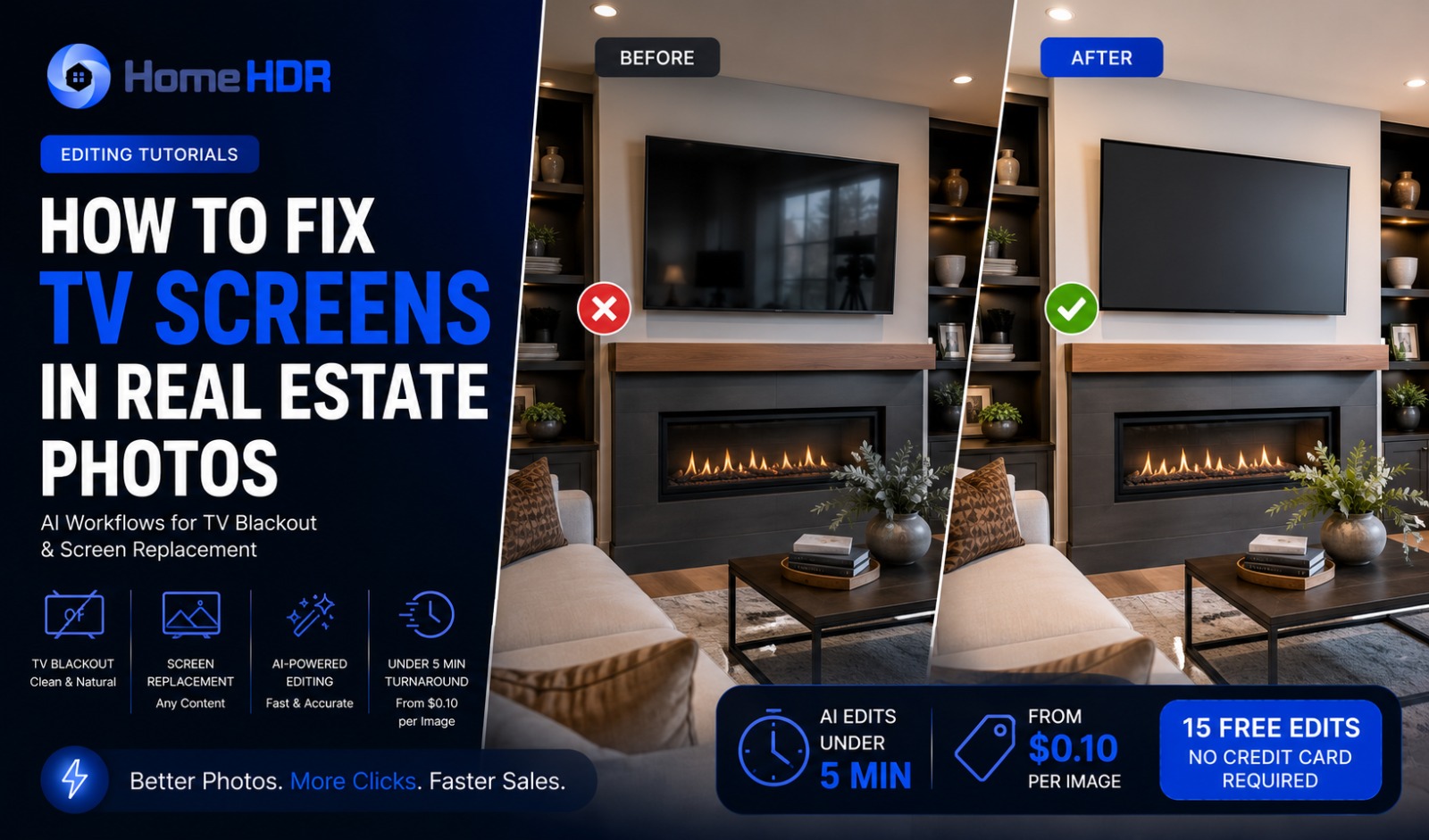
Quick answer: A bad TV in a listing photo is almost always one of three things: the screen goes jet-black, glares as a bright square, or shows a reflection of the photographer or flash. The 2026 workflow is AI-first. Upload the photo to a real estate AI editor like HomeHDR and both TV blackout (a clean matte-off screen) and TV screen replacement (fireplace, landscape, or custom fill) run natively as part of the standard edit. Turnaround is under 5 minutes, from $0.10 per image, with 15 free edits and no credit card required. No MLS or NAR disclosure is required for a TV screen edit. Below is the full workflow: why TVs photograph badly, how to shoot cleaner sources, the AI-first fix, what content to display, disclosure rules, and per-photo cost.
We've processed 5,000+ real estate listing photos for 500+ photographers across the USA, and if there's one recurring problem that separates a $1,200 photographer from a $250 one, it's what they do about the television.
Nobody notices a good TV in a listing photo. Everybody notices a bad one. A dead black rectangle over the fireplace, a photographer's silhouette staring back through the glass, a harsh bright square from the Netflix menu. Any of these can quietly cost a listing thousands of buyer clicks on Zillow. In this guide we'll walk through why TV screens photograph badly, the AI-first workflow that fixes them, what to actually display on the screen, MLS disclosure rules, and per-photo cost across the services most photographers use in 2026.
Why do TV screens look bad in real estate photos?
If your listing photo has a mounted TV and something feels off about the room, the TV is almost always the reason. In our editing queue we see the same three failure modes every single week:
- The screen reads as a dead black rectangle. With the TV off, a 65-inch black void sits in a warmly lit living room like a hole punched into the wall. The eye follows contrast, and a jet-black rectangle wins every time. This is the number-one reason a black TV screen in a listing photo gets flagged for reshoot.
- The screen glares as a harsh bright square. With the TV on, whatever content is displayed (a paused movie, a streaming home page, a station logo) becomes the brightest thing in the frame and competes with the actual room.
- The screen shows a reflection of the photographer, tripod, or flash. A modern TV is basically a dark mirror. One speedlight pop or a badly positioned tripod, and you've got a photographer reflection in a TV screen sitting in the middle of your hero shot.
The compound effect is subtle but expensive: buyers scrolling on Zillow subconsciously register the room as "cold," "cluttered," or "off" without knowing why. In every case we've audited, the TV was the reason.
Should you turn the TV on or off during a real estate shoot?
Off. Every time. After thousands of processed photos, this answer isn't close.
Turning the TV on almost never helps. Even a neutral wallpaper or the manufacturer's demo screen clashes with the room's warmth and reads as a distraction. Show a Netflix menu or a paused show and the photo now dates itself. A listing that took two months to sell will still have a 2026 Netflix home screen sitting in it three years later.
Turning the TV off gives you the cleanest starting point. The screen area itself then gets handled in the editing pipeline, and in the 2026 AI workflow that step is automatic.
How do you photograph a TV in a real estate shoot?
Editing is faster and cleaner when the source photo is good. These are the on-site habits that eliminate most reflections and glare before the file ever hits an editor:
- Confirm the TV is off in the viewfinder: no standby glow, no clock display, no HDMI logo. Check every single shot with a TV in frame, not just the wide.
- Watch for reflections in the screen preview. Move the tripod 6-12 inches left or right until neither you nor the flash appears in the glass.
- Angle the shot 10-15° off-axis from the TV. A slight angle massively reduces reflections and reads as more natural composition. Dead-on TV shots are amateur signature.
- Add a polarizing filter on exterior-facing walls with lots of window light. Polarizers cut TV glare significantly at the cost of about a stop of ambient light, and a tripod handles the light loss.
- Bracket exposures with the TV in frame. A 5-frame AEB sequence gives the AI editor multiple exposures to reconstruct the screen area cleanly, especially in mixed-light rooms.
Every one of these habits comes from an editor calling a photographer at 6pm asking why the same TV reflection is in every third shot. Get them right on-site and the AI editor has a much easier job.
The AI-first TV screen fix: TV blackout vs TV screen replacement
Here's what's changed since 2023: fixing a TV in a real estate photo is no longer a manual Photoshop task. Modern real estate AI editors handle it natively as part of the standard listing edit.
HomeHDR offers two dedicated TV treatments as part of the automated pipeline, with turnaround under 5 minutes per photo, starting at $0.10 per image:
- TV blackout. A clean matte-off screen with a subtle glass sheen, the modern minimalist option. Perfect for contemporary listings, luxury builds, and any room where a fireplace image would feel dated. This is what "no more black rectangle in an otherwise great room" actually looks like in a finished photo.
- TV screen replacement. The screen is filled with a realistic image: a warm fireplace loop still, a landscape, or a subtle scene that adds warmth without stealing focus. It runs alongside HomeHDR's fireplace fire effects feature, so on rooms with both a TV and a physical fireplace you can bring warmth to both at once.
The AI also cleans up the surrounding problems automatically as part of the same edit:
- HDR merge blends 3-9 brackets into one balanced exposure, so the shadows around the TV are resolved before any screen fill is applied.
- Window pull balances interior with any bright windows behind the TV.
- Perspective correction straightens the TV in-frame automatically.
- Object and clutter removal handles remote controls, cords, and console clutter around the TV console.
- Sensitive information blurring takes care of any personal photos, mail, or documents visible near the TV, a compliance saver on live-in listings.
Everything runs in one pass, in under 5 minutes, at $0.10 per image on entry-level plans. There's no "TV screen replacement add-on" charge. It's part of the standard edit, and that's the reason most working photographers stopped doing this by hand.
The manual Photoshop method (if you're editing by hand)
For photographers who edit fully in-house and prefer manual control, the traditional Photoshop workflow still works. It just doesn't scale.
The compressed 5-step version:
- Open the photo in Photoshop and duplicate the base layer.
- Select the screen with the Polygonal Lasso: four clicks, one per corner. Feather 0.5-1 px.
- Paste in your fill (fireplace, landscape, or matte grey) and press Cmd/Ctrl + T then Distort to snap the four corners to the TV frame.
- Drop opacity to 85-95% and add a very subtle diagonal gradient overlay at 5-10% for realistic screen sheen.
- Color-match the fill to the room's ambient temperature with a Photo Filter adjustment layer.
Time per screen: 3-8 minutes for a skilled editor. On a 35-photo listing with 3-5 TVs, that's an extra 15-40 minutes on top of your normal HDR, color, and perspective work. The reason volume photographers have moved to AI-first workflows is not that Photoshop stopped working. It's that spending 40 minutes on TVs per listing stops making sense at the fifth listing of the week.
What should you display on a TV screen in a listing photo?
When you do fill the screen (rather than blacking it out), the right choice depends on the property. Here's the four-option matrix we use internally when reviewing HomeHDR edits:
| Fill style | Best for | Season | Practical example |
|---|---|---|---|
| Fireplace / hearth | Living rooms, dens, family rooms | Fall / winter listings | Warm out-of-focus flame loop still |
| Landscape / nature | Coastal, mountain, view properties | Spring / summer listings | Muted sunset over water for waterfront; forest for mountain |
| Matte-off (TV blackout) | Modern, minimalist, luxury contemporary | Any season | Subtle dark surface with 5% diagonal gradient sheen |
| Property's own view | Luxury only, view-selling listings | Any season | The literal exterior view shown on the screen, a subtle "look what this overlooks" nod |
Never leave a streaming logo, channel banner, or brand mark on the TV. In our audits, this is the single fastest way to make an otherwise good listing photo look amateur. It also dates the photo. A 2026 Netflix home screen in a listing photo will still be there when the property re-lists in 2029.
Do you have to disclose TV screen replacement in MLS photos?
Short answer: no MLS or NAR rule in North America requires you to disclose a TV screen replacement.
Longer answer, from working across dozens of MLSs: TV screen replacement is a cosmetic edit that does not misrepresent the property. It doesn't hide damage, doesn't alter permanent features, doesn't change what the buyer sees when they walk through the door. That places it in the same "safe" editing category as removing a trash can, straightening verticals, or correcting white balance.
NAR's Code of Ethics Article 12 requires REALTORS® to "present a true picture" of the property in advertising. Replacing a black rectangle with a matte fill or a fireplace image doesn't cross that line. The TV is still there in the room, the same size, in the same place, doing the same job. What you can't do is use a TV screen edit to hide something: a cracked screen the seller isn't planning to replace, for example, or a wall crack behind the TV that would be visible when the TV is uninstalled.
Rule of thumb: if the edit doesn't change what a buyer would see on a walkthrough, no disclosure is needed. If you're ever unsure, review what you can and can't remove from a listing photo, which covers the same disclosure line in more detail, and check your specific board's editing rules. Most publish them publicly.
How much does TV screen replacement cost per photo?
Real 2026 economics, based on the three ways working photographers actually handle it:
| Approach | Cost per photo | Turnaround | What's included |
|---|---|---|---|
| HomeHDR (AI) | From $0.10 | Under 5 minutes | Full pipeline: HDR merge, window pulls, perspective, color, TV blackout or TV screen replacement, object removal, all in one edit. 15 free edits, no credit card. |
| Outsourced human editors (BoxBrownie / PhotoUp) | $1.60-$3.20 per photo (add-on) | 12-24 hours | Human editor handles the TV fill step manually |
| Manual in-house Photoshop | ~$4-$15 per photo in labor time | Same day (your time) | Full manual control, doesn't scale |
| Full outsource (all editing, all TVs) | $1.50-$3.00 per photo | 12-24 hours | Entire listing handled by a human service |
For a photographer delivering 5 listings a week (~175 photos), the full HomeHDR pipeline runs about $17.50 per week with under-5-minute turnaround, versus $260-$525 per week for full human outsourcing at 12-24 hour turnaround. HomeHDR also backs the entire service with a 60-day money-back guarantee and a 2X refund if you don't save at least 10 hours a month in editing time, a guarantee no outsourced service in the category offers. If you're pricing out the in-house alternative instead, the real estate photography equipment checklist breaks down what a full editing stack costs to run.
Key takeaways
- TVs photograph badly because they read as black voids, harsh bright squares, or reflective mirrors, all of which quietly hurt listing click-through.
- Turn the TV off during every shoot; angle the shot 10-15° off-axis; check for reflections in the viewfinder.
- HomeHDR handles both TV blackout and TV screen replacement natively as part of the standard AI edit: under 5 minutes per photo, from $0.10 each, 15 free edits with no credit card.
- Best fill styles: fireplace (warm/cozy), landscape (seasonal), TV blackout (modern), or property view (luxury only).
- No MLS or NAR disclosure is required for TV screen replacement. It's a cosmetic edit, not a misrepresentation, unless you're using it to hide damage.
- The manual Photoshop method still works but takes 3-8 minutes per screen and doesn't scale past a few listings a week.
Frequently asked questions
How do you fix a black TV screen in a real estate photo? The 2026 workflow is AI-first. Upload the photo to a real estate AI editor like HomeHDR. TV blackout (matte-off finish) and TV screen replacement (fireplace, landscape, or custom fill) run automatically as part of the standard edit, along with HDR merge, window pulls, perspective correction, and color. Turnaround is under 5 minutes per image at $0.10 each. Manual Photoshop still works (Polygonal Lasso the screen, paste a fill, distort to the corners, drop opacity to 90%) but takes 3-8 minutes per screen and doesn't scale.
Should I turn the TV on or off when shooting listing photos? Off. Turning the TV on introduces distracting content, clashes with the room's warmth, and dates the photo (a visible streaming menu will still be there when the listing re-lists three years later). Shoot with the TV off and let the AI editor handle the screen area for the cleanest professional result.
Is it legal to replace the TV screen in a real estate photo? Yes. TV screen replacement is a cosmetic edit that doesn't misrepresent the property. No MLS or NAR rule in North America requires disclosure. The only edge case is if you're using the replacement to hide damage (a cracked screen the seller isn't replacing, a wall crack behind the TV). That would cross into misrepresentation under NAR Article 12.
Can AI replace TV screens in real estate photos automatically? Yes. HomeHDR handles both TV blackout (matte-off) and TV screen replacement (fireplace, landscape, custom fill) as native features inside the standard AI editing pipeline. It runs alongside HDR merge, window pulls, perspective correction, color correction, and object removal in a single upload: under 5 minutes per photo, from $0.10 each.
What should you display on a TV screen in a listing photo? A warm fireplace image is the most universally flattering and works in 90%+ of living rooms. A landscape works well for summer listings and view properties. TV blackout (a subtle matte-off finish) suits modern and minimalist homes. On luxury view properties, showing the actual outside view on the screen is a subtle premium touch. Never leave streaming menus, brand logos, or paused content on the TV.
How much does TV screen replacement cost per photo? HomeHDR handles TV screen replacement (and TV blackout) as part of the standard edit at $0.10 per photo on entry-level plans, with a 15-image free trial and no credit card required. Outsourced human editors like BoxBrownie or PhotoUp charge $1.60-$3.20 per photo as an add-on with 12-24 hour turnaround. Manual in-house Photoshop costs $4-$15 per photo in labor time.
How do you avoid TV reflections during a real estate shoot? Angle the shot 10-15° off-axis rather than dead-on, move the tripod 6-12 inches to remove any photographer or flash reflection visible in the screen preview, add a polarizing filter on rooms with heavy window light, and confirm the TV is fully off in the viewfinder before each frame. These habits save 5-10 minutes per listing at the editing desk.
Do I need to disclose TV screen edits to buyers? No. TV screen replacement doesn't change what a buyer sees on a walkthrough. The TV is still there, same size, same place. It falls in the same safe-editing category as removing a trash can or straightening verticals. Disclosure is only required if the edit hides something the buyer needs to know about (structural damage, permanent fixtures, cracked screens the seller isn't replacing).
Stop editing TV screens one at a time. HomeHDR handles TV blackout and TV screen replacement natively as part of the standard AI edit, alongside HDR merge, window pulls, perspective correction, and color, in under 5 minutes per photo from $0.10 each. Try 15 free edits.
By the HomeHDR Team.