Updated: November 2, 2026 · By the HomeHDR Team.
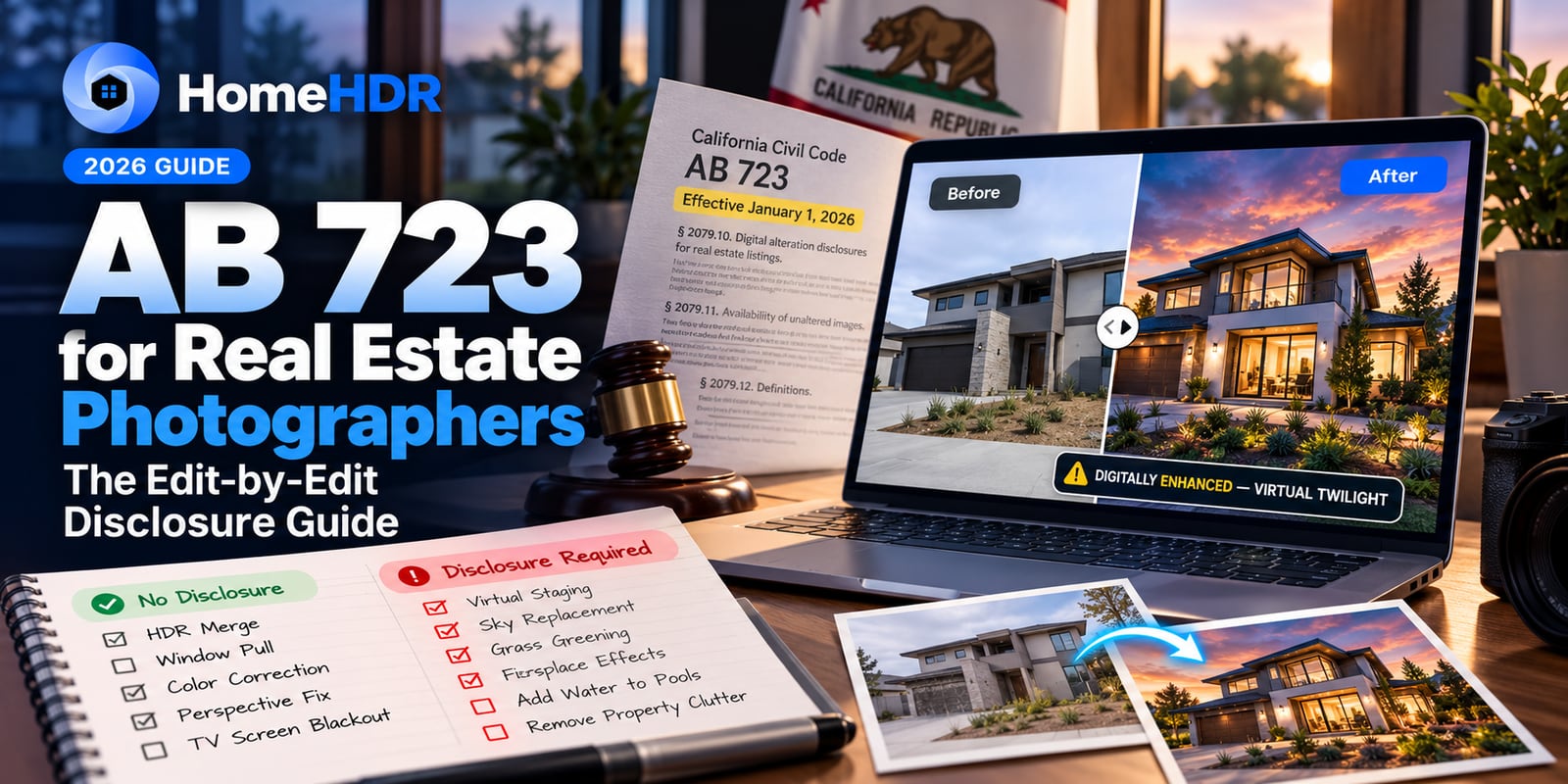
Quick answer: California AB 723 took effect January 1, 2026 and requires conspicuous MLS disclosure for any real estate listing photo edit that changes how the property materially appears, specifically adding fireplace effects, greening grass, removing clutter that is part of the property, adding water to pools, replacing skies, or applying virtual twilight / virtual staging. Routine corrective edits, HDR merge, window pull, white balance, perspective straightening, lens-flare removal, TV screen blackout, dust-spot cleanup, and blurring of faces or license plates, do not require disclosure, because they adjust capture artifacts rather than the property itself. HomeHDR flags every edit explicitly as disclosure-required or enhancement-only in the output pipeline, holds source files for the 7-day disclosure-link workflow, and charges the same $0.36–$0.55 per photo regardless of edit type, with under 5-minute turnaround, 15 free edits and no credit card. The master edit-by-edit table, the practical caption language, and the state-by-state ripple are below. This is not legal advice; consult counsel for your jurisdiction.
You've shot the exterior at 2pm with a 24-105 on a tripod, bracketed cleanly, and the agent's text came in before you got back to the car: "can we get a dusk shot?" The actual-dusk re-shoot would mean driving back at 7pm, repositioning, blocking traffic, and probably one window light that wasn't on. The virtual twilight edit does it in 4 minutes. The question that eats the next 20 minutes isn't whether to do the edit, it's whether you have to tell anyone, and if so, how.
This is the working-photographer and working-agent reference for California AB 723, what it actually says, which edits need the disclosure flag, which don't, and the practical label that satisfies the statute without making the listing read like a legal document. The edit-by-edit table is the piece most photographers screenshot and keep on a second monitor.
What is California AB 723 and why did it pass?
Direct answer: AB 723 is a California statute signed in 2025 and effective January 1, 2026 that requires any MLS listing photo which has been digitally altered to change how the property materially appears to carry a conspicuous disclosure on the listing, and to make the unaltered version of the image available on request. The intent is to close the gap between what a buyer sees online and what they walk into in person, a gap that widened as AI editing made virtual staging, sky replacement, and virtual twilight nearly indistinguishable from the real thing in a thumbnail.
The bill was carried by consumer-protection sponsors (CAR did not oppose) in response to a measurable uptick in complaint filings with the California Department of Real Estate about buyers traveling significant distances for in-person tours of listings whose online photos they later described as "not the same house." The statute does not forbid any specific edit; it requires transparency about which edits were applied.
The practical effect for a working photographer is narrower than the headline sounds. Routine capture-cleanup (HDR merge, window pull, color correction, lens-flare removal) is explicitly outside the disclosure requirement, because those edits address the camera's limitations rather than the property. The edits that require disclosure are the ones that make something be in the photo that isn't in the house.
Which edits require AB 723 disclosure? The master table
Direct answer: The edit-by-edit disclosure framework comes down to one question: "does this edit change what a buyer would see standing in the room?" If yes, disclose. If no (because the edit addresses a camera artifact, a transient on-screen content, or a privacy requirement), no disclosure. The 12 most common real estate photo edits break down as follows under AB 723 as currently interpreted and reported by Inman, Realtor.com, and the California Department of Real Estate's January 2026 guidance.
| Edit type | Disclosure under AB 723? | Statutory reasoning |
|---|---|---|
| HDR bracket merge | No | Addresses camera dynamic-range limitation; no change to property |
| Window pull (highlight recovery through windows) | No | Addresses camera dynamic-range limitation; the view out the window is already physically there |
| White balance / color correction | No | Addresses capture technique; the room is the same color in person |
| Perspective correction / vertical straightening | No | Addresses camera tilt artifact; walls are physically vertical in the room |
| Lens flare / lamp glare removal | No | Transient optical artifact; the glare isn't a property feature |
| Dust spot / sensor spot cleanup | No | Addresses sensor artifact |
| TV screen blackout or replacement | No | Removes transient on-screen content; the TV itself is still shown, bezel and mount preserved |
| Blurring faces, license plates, house numbers | No | Privacy requirement; baked into the exported file for buyer protection |
| Object removal: transient items (trash bins, cars, hoses, tenants' pets) | No | Items are not property features and are not permanent |
| Sky replacement | Yes | Changes time of day / weather / season as presented |
| Virtual twilight (daytime → dusk) | Yes | Changes time of day as presented |
| Virtual staging (adding furniture to empty rooms) | Yes | Adds a material visual element that could influence buyer perception of space / use |
| Fireplace fire added (empty fireplace → lit fire) | Yes | Adds a feature state the buyer would not see at tour time without staging |
| Grass greening (dormant / brown → lush green) | Yes | Changes seasonal appearance / implies lawn condition |
| Pool water added (empty pool → full with water) | Yes | Changes material property state |
| Object removal: permanent features (satellite dish, shed, power line, roof damage) | Yes | Alters the actual property condition |
| Weather / condition changes (snow removal, rain removal from pavement) | Yes | Changes seasonal / weather context |
| Crack / stain / damage cleanup on surfaces | Yes | Changes material condition of the property |
The pattern is consistent: routine capture cleanup is enhancement; adding, removing, or state-changing something a buyer would observe in person is disclosure. The borderline cases (TV screen replacement, perspective aggression on a very small room, blurring a For Sale sign that happens to be a neighbor's) are read by current counsel on the enhancement side as long as the underlying property is not altered.
How do you disclose an AB 723 edit on an MLS listing?
Direct answer: The statute requires a conspicuous disclosure attached to the altered image and availability of the unaltered image on request. "Conspicuous" is not pixel-defined in the statute; the DRE's January 2026 guidance and current CAR practice settle on a visible footer caption on the image, a line in the listing description, or a tag flag in the MLS photo metadata, depending on the MLS's current tooling. The unaltered-image requirement is satisfied by holding the source file in a retrievable location for the length of the listing.
The practical captions most photographers and brokerages are converging on:
| Edit disclosed | Sample caption text |
|---|---|
| Virtual twilight | "Digitally enhanced: virtual twilight. Daytime photo available on request." |
| Sky replacement | "Digitally enhanced: sky replaced. Original photo available on request." |
| Virtual staging | "Virtually staged. The home is currently vacant. Unstaged photo available on request." |
| Fireplace fire added | "Digitally enhanced: fireplace effect added. Original photo available on request." |
| Grass greening | "Digitally enhanced: lawn appearance. Photo taken in [month]; original available on request." |
| Pool water added | "Digitally enhanced: pool filled for presentation. Original photo available on request." |
The caption lives either in the image itself as a visible footer bar (most defensible), in the alt text/caption field of the MLS, or in the general listing description with the specific image referenced. The best-practice combination, where the MLS allows it, is a visible on-image caption plus a line in the listing description that enumerates which images were altered and how.
The unaltered-image availability requirement is where the 7-day source-file retention of a modern editing workflow earns its keep. When a buyer or buyer's agent requests the original, the listing agent needs to be able to produce it, and the clock in the statute is measured in days, not weeks.
What happens if you don't disclose a required AB 723 edit?
The enforcement structure of AB 723 sits in three layers.
Layer 1: civil remedy to the buyer. A buyer who closes on a property and later establishes that an undisclosed material edit influenced their decision can seek contract remedies (rescission in extreme cases, damages in more common cases) under California's existing material-misrepresentation doctrine, now anchored by the AB 723 disclosure duty. The statute does not create a new tort; it codifies the disclosure duty and makes failure to comply unambiguous evidence of material misrepresentation.
Layer 2: DRE discipline against the listing agent and brokerage. The DRE in its January 2026 guidance stated it will treat failure to disclose a material edit as a violation of the licensee's duty to deal honestly, which can result in fines, license suspension, or revocation. Discipline risk sits primarily with the agent and brokerage, not the photographer directly, but a photographer whose work was represented as unaltered when it wasn't can be named in the discipline record and in any civil action.
Layer 3: MLS board sanctions. Most California MLS boards (CRMLS, Bright MLS West, Bay Area MLSs) updated their photo policies in Q4 2025 to require AB 723 compliance as a condition of listing input. Non-compliance can result in listing removal, fines, and member-status consequences.
The practical takeaway: the risk is real and distributed across every party in the listing chain. The simplest defense is routine disclosure on every edit that falls in the "yes" column, not case-by-case judgment on borderline-looking exteriors.
How does AB 723 interact with NAR Code of Ethics Article 12-5?
NAR Code of Ethics Article 12-5 is the long-standing national standard requiring REALTORS® to present a "true picture" in advertising. The relationship between NAR 12-5 and California AB 723 is layered:
- NAR 12-5 is enforceable by MLS boards and local REALTOR® associations as a condition of membership; AB 723 is enforceable by the DRE and the civil courts.
- NAR 12-5 is intentionally broad ("true picture"); AB 723 is more specific about what triggers disclosure.
- A real estate photo edit that satisfies AB 723 compliance (proper disclosure caption, source file available) almost always also satisfies NAR 12-5.
- An edit that fails AB 723 compliance usually also fails NAR 12-5, exposing the agent to both DRE discipline and REALTOR® association sanction.
For a photographer or agent working across California, the practical standard is "comply with AB 723 and NAR 12-5 is covered." For a photographer or agent working outside California in a jurisdiction without AB-723-equivalent statute, the practical standard is "comply with NAR 12-5, which for 2026 effectively means the AB 723 disclosure framework anyway, because every national brokerage has adopted it as policy."
Which other states have passed AB-723-style disclosure rules?
Direct answer: As of October 2026, five states have passed or introduced AB-723-equivalent statutes, with another seven in active committee review. The regulatory direction is consistent with California's framework (material-edit disclosure, source-file availability) and most national brokerages have adopted California's standard as internal policy regardless of state, which effectively nationalizes the AB 723 framework.
| State | Status | Effective | Scope vs AB 723 |
|---|---|---|---|
| California | Enacted | 2026-01-01 | Baseline |
| Texas | Enacted | 2026-07-01 | Same framework, broader damages |
| Florida | Enacted | 2026-09-01 | Same framework, narrower scope (no virtual staging requirement) |
| New York | Enacted | 2027-01-01 (scheduled) | Broader: includes exterior landscaping edits |
| Washington | Enacted | 2026-10-01 | Same framework |
| Oregon | Introduced | TBD | Same framework pending |
| Colorado | Introduced | TBD | Same framework pending |
| Massachusetts | Introduced | TBD | Narrower: residential only |
| Arizona | Introduced | TBD | Pending |
| Virginia | Introduced | TBD | Pending |
| Illinois | Introduced | TBD | Same framework pending |
| North Carolina | Introduced | TBD | Pending |
The practical implication for a photographer working across state lines: adopt the AB 723 framework as the default workflow regardless of jurisdiction. The marginal cost of applying the disclosure caption to an edit that doesn't technically require it in your state is near-zero; the cost of missing the caption on an edit that does is a listing takedown, a license complaint, or a civil claim.
How does the AB 723 compliance workflow actually run?
The practical workflow most working photographers and brokerages are converging on in 2026 is a four-step process baked into the editing pipeline.
Step 1: Edit classification at upload. When a photo enters the editing workflow, each edit requested is tagged against the disclosure table above. In a manual Photoshop workflow, this is a mental step; in an AI-first workflow, the pipeline flags disclosure-required edits automatically and prompts the photographer or agent to confirm.
Step 2: Caption generation. For every edit that falls in the "disclose" column, the pipeline generates the sample caption text (from the table above or a brokerage-specific template) and offers to burn it into the exported image as a bottom footer bar, or to add it to the alt-text / caption field of the export metadata, or both.
Step 3: Source file retention. The source bracketed capture (or the un-edited single-exposure file) is held in a retrievable location, the editor's cloud storage, the brokerage's MLS asset library, or the AI editing service's source-file retention window (HomeHDR holds source files for 7 days alongside the edited output).
Step 4: Listing input. When the agent inputs the listing, the altered image carries its caption, the listing description includes the disclosure line, and the request path for the unaltered image is noted. The MLS board's compliance review flags any altered image without a disclosure caption during listing input (increasingly automated as of mid-2026).
The honest friction point is Step 2, a visible on-image caption on a hero exterior shot reads clumsy to some agents and sellers who want the "clean" listing look. The best-practice compromise is a small, bottom-right 5–8pt caption in a sans-serif font with a 60% opacity white or black background, which satisfies "conspicuous" without dominating the image.
Manual edit classification vs AI edit classification
The time cost of AB 723 compliance scales linearly with volume on a manual workflow and flat on an AI-first workflow.
| Workflow | Classification time per photo | Caption generation | Source file retention | Total compliance time per listing (30 photos) |
|---|---|---|---|---|
| Manual Photoshop (in-house) | 20–30 seconds (mental) | 2–3 minutes per flagged edit | Manual folder archive | 10–15 minutes added per listing |
| Offshore outsourced | Specified at brief | Instructions must be sent per edit | Dropbox or similar hand-off | 15–20 minutes added per listing (brief + review) |
| AI editing (HomeHDR) | Automatic: flagged at upload | Automatic from edit catalog | Automatic: 7-day retention of source + edited | Under 1 minute of review per listing |
For a photographer running 5 listings a week with 4–6 disclosable edits across the gallery, the compliance time math compounds the same way the edit time math does, 15 minutes per listing times 5 listings per week times 50 weeks is 62.5 hours a year on AB 723 compliance alone, before the editing itself.
Where HomeHDR fits
HomeHDR handles AB 723 compliance as part of the standard editing pipeline. Every edit is tagged against the master table above at upload; disclosure-required edits (sky, virtual twilight, virtual staging, fireplace fire, grass greening, pool water) are flagged on the output with an optional on-image caption footer and a disclosure line added to the output metadata. Source files are retained for 7 days alongside the edited images for the unaltered-on-request workflow.
- Compliance tagging: every edit flagged as "disclose" or "enhancement" at output.
- Caption generation: optional on-image caption or metadata-only; brokerage-template support.
- Source retention: 7 days from render.
- Turnaround: under 5 minutes per photo including the compliance tagging.
- Pricing: $0.36–$0.55 per photo, same price regardless of edit type or disclosure flag.
- Free tier: 15 free edits, no credit card.
- Guarantees: 60-day money-back + 2× refund if the first month doesn't save at least 10 hours + unlimited free re-renders on quality-match issues.
What HomeHDR won't do: issue legal advice on your specific listing or jurisdiction, override a brokerage-specific disclosure policy, or guarantee compliance in a state whose statute has not yet been published. For every one of those cases, the answer is the same, consult counsel, consult your broker, consult your MLS. What HomeHDR does do: make the routine compliance work on a 30-photo listing a 1-minute review step rather than a 15-minute brief-and-check loop.
Key takeaways
- AB 723 took effect January 1, 2026 in California, with four additional states having passed similar statutes and seven more in committee review.
- The disclosure trigger is "would the edit change what a buyer sees in person?" Capture cleanup (HDR, window pull, color, perspective, dust-spot, TV blackout, blur) does not require disclosure.
- The edits that do require disclosure: sky replacement, virtual twilight, virtual staging, fireplace fire added, grass greening, pool water added, removal of permanent property features, weather/condition changes, damage cleanup.
- Compliance = conspicuous disclosure caption + source file available on request. The caption lives on the image, in the alt-text / caption field, or in the listing description, ideally all three.
- Non-compliance risk is distributed across civil action, DRE discipline, and MLS board sanction.
- National brokerages have adopted AB 723 as policy across all states, which effectively nationalizes the framework regardless of local statute.
- Source file retention needs to run for the length of the listing, or at minimum for a window long enough to service the unaltered-on-request duty.
- AI editing with built-in compliance tagging compresses the per-listing compliance time from ~15 minutes to ~1 minute.
- This is not legal advice. The AB 723 framework is new, actively interpreted, and jurisdiction-dependent, consult counsel for your specific listing and your specific state.
Frequently asked questions
What exactly is California AB 723? AB 723 is a California statute effective January 1, 2026 that requires MLS listing photos which have been digitally altered in a way that changes how the property materially appears to carry a conspicuous disclosure, and to make the unaltered version of the image available on request. It does not forbid any specific edit, it requires transparency about which edits were applied.
Which real estate photo edits require AB 723 disclosure? Edits that change how the property materially appears: sky replacement, virtual twilight (daytime to dusk), virtual staging (adding furniture to empty rooms), fireplace fire added, grass greening, pool water added, removal of permanent property features (satellite dish, shed, power line, roof damage), weather or seasonal changes, and crack / stain / damage cleanup. Capture cleanup edits, HDR merge, window pull, color correction, perspective straightening, lens-flare removal, TV screen blackout, blurring faces or license plates, removal of transient items like trash bins, do not require disclosure.
How do I disclose a virtual twilight or sky replacement on an MLS listing? The practical standard is a conspicuous caption on the image ("Digitally enhanced: virtual twilight. Daytime photo available on request.") combined with a line in the listing description noting which images were altered. The source (unaltered) photo must be available on request for the length of the listing.
Does AB 723 apply outside California? Not directly. AB 723 is a California statute. However, four other states (Texas, Florida, Washington, New York) have passed equivalent statutes effective 2026–2027, seven more are in committee review, and most national brokerages have adopted the AB 723 framework as internal policy across all states, which effectively nationalizes it in practice.
Who is liable if an AB 723 edit isn't disclosed? Liability is distributed: the buyer can bring a civil claim for material misrepresentation against the listing agent and brokerage, the DRE can discipline the licensee, and the MLS board can sanction or remove the listing. A photographer whose work was represented as unaltered when it wasn't can be named in the discipline record or civil action, though primary liability sits with the agent and brokerage.
Does TV screen replacement require AB 723 disclosure? No. TV screen blackout and TV screen replacement are enhancement edits, they remove transient on-screen content without altering the TV, the mount, or any permanent property feature. The bezel, wall mount, and cables stay untouched in the output, and the display content is a temporary artifact of whatever the current occupant has on the screen.
Does blurring faces or license plates require AB 723 disclosure? No. Privacy blur is a protective edit required for buyer and tenant privacy; it does not change the property. The blur is baked into the exported file. The underlying property features (the car, the person, the house number) are not property-material.
What's the sample caption for a virtually staged photo? A practical caption is "Virtually staged. The home is currently vacant. Unstaged photo available on request." The caption should be visible on the image, and the listing description should include a line noting which images were virtually staged. The unaltered (vacant-room) photo must be retrievable on request.
How long do I need to keep the source files for AB 723 compliance? The statute does not specify a retention length; the practical standard is the length of the listing plus a reasonable post-close window. Industry practice is converging on 30–90 days post-close, with most MLS boards recommending at least 30 days. HomeHDR holds source files for 7 days alongside edited images, brokerages requiring longer retention should sync source files to their own storage during that window.
What happens if I disclose an edit that didn't actually require disclosure? Nothing adverse. Over-disclosure is not penalized under AB 723 or NAR 12-5, and some brokerages are adopting a routine-disclose-everything policy as the simplest administrative stance. The downside is only aesthetic (more caption lines on the listing) which many agents accept as the cost of avoiding borderline-case judgment.
Does AI editing automatically handle AB 723 compliance? AI editing trained on real estate (HomeHDR) flags disclosure-required edits at output, generates the caption text, and retains source files for the unaltered-on-request workflow. The compliance decision (whether to apply the on-image caption, the metadata caption, or both) remains with the agent and the brokerage. The AI handles the mechanical steps; the compliance ownership stays with the licensee.
Is this article legal advice? No. This article summarizes the published statutory framework and current industry practice as of October 2026, but AB 723 is new, actively interpreted by the DRE, the MLS boards, and the courts, and its practical application varies by jurisdiction and listing. For your specific listing and your specific state, consult counsel.
Edit faster, disclose cleanly. HomeHDR flags every disclosure-required edit automatically, generates the AB 723 caption, and retains source files for the unaltered-on-request workflow, all in under 5 minutes per photo at $0.36–$0.55. Start with 15 free edits, no card required.
By the HomeHDR Team. Reviewed by the HomeHDR senior editor. Not legal advice.
Keep reading
- Sky Replacement in HomeHDR: Swap a flat, washed-out sky for one that makes the exterior sell.
- Fireplace Fire in HomeHDR: Light an empty grate so a winter listing feels warm and lived-in.
- MLS Photo Requirements 2026: AI Disclosure, Editing Rules & Compliance Guide
- Sky Replacement in Real Estate Photography (2026): MLS Disclosure, AI Workflow and Cost
- Object Removal in Real Estate Photos (2026): What Is Safe and What Needs Disclosure