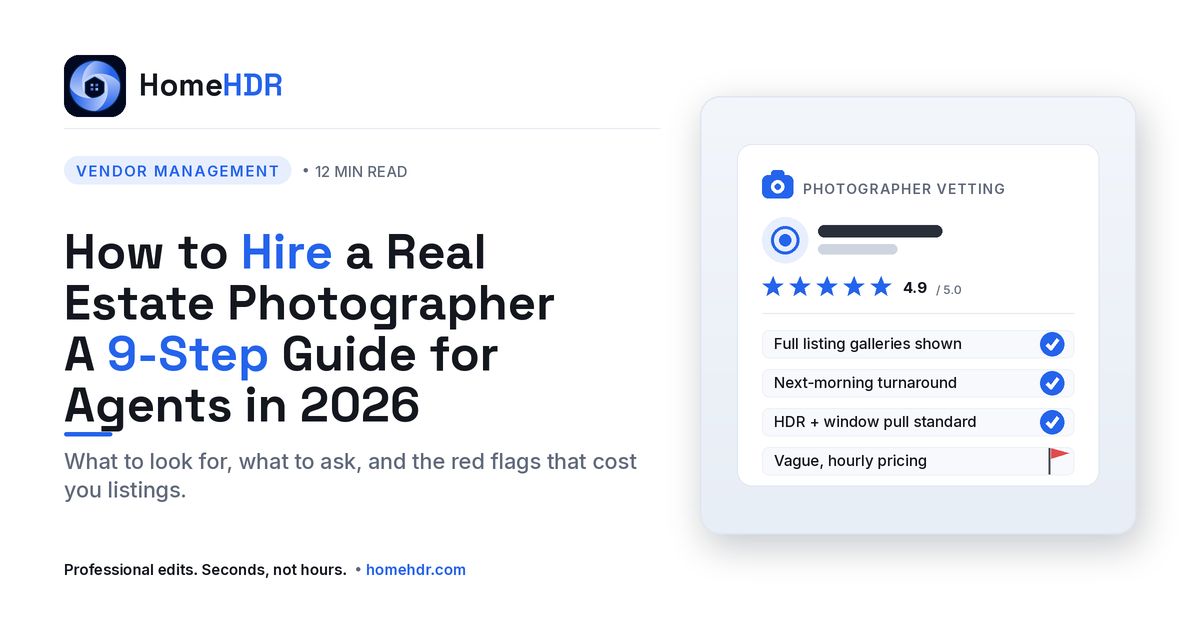
TL;DR: Hiring the right real estate photographer is a high-leverage decision that affects every listing you take for the next 12 months. The best vetting process is 9 steps: define your needs, source 4-6 candidates, review their full listings (not their highlight reel), test their turnaround promise, validate their tech stack, agree on pricing tiers, run a paid trial shoot, get the contract right, and build the long-term relationship. This guide walks you through each step, including the red flags that should make you walk and the questions that reveal real talent.
Most agents hire photographers the way they hire dentists: they ask a friend, take whoever's available, and stay loyal for years even when the relationship has stopped working. That's understandable. It's also expensive, because the photographer you hire is, statistically, the single biggest non-agent factor in how fast your listings sell.
The good news: this isn't hard once you have a process. Below is the same 9-step playbook the top 1% of agents I've talked to use when they hire (or fire) a real estate photographer. It takes about 4 hours of work upfront and saves you years of mediocre listings.
Why hiring the right photographer is a multi-listing decision
Here's the math most agents skip. If you take 24 listings a year and your photographer is 5% better than your competitors' photographers, that's roughly:
- +1.2 listings/year of avoided "drop in price" conversations
- 6-8 days lower average days on market
- $8,000-$15,000 in additional commission income (depending on price point)
- Real referrals from sellers who are impressed by their listing presentation
A small quality delta in your photographer compounds over a year into real money. Hiring well is not a soft skill, it's a P&L decision.
Now, the process.
Step 1. Define what you actually need before you start looking
Most agents skip this and end up hiring whoever is in their inbox. Spend 20 minutes answering these questions on paper:
- Average price point of your listings? ($200K, $400K, $400K, $800K, $800K, $1.5M, $1.5M+), this dictates your photo budget.
- Volume per month? (1-2, 3-5, 6-10, 10+), high volume needs a photographer with capacity.
- Geography? Mostly downtown? Mostly suburban? Lots of travel? Most photographers prefer a 30-minute radius.
- What add-ons do you sell? Standard interior only, or twilight + drone + video as part of your listing presentation? You need a photographer who can deliver every add-on you market.
- Turnaround you promise sellers? 24 hours, 48 hours, 72 hours? Match the photographer to your promise.
- Style preference? Bright and airy (light, modern, white-walled)? Warm and saturated (luxury, hospitality feel)? True-to-life? Photographers have signatures, pick one that matches your listings.
Write down your answers. Use them as a filter in the next steps.
Step 2. Source 4-6 candidates the right way
Two sources beat all others:
Source A, Reverse search the best-shot MLS listings in your area. Pull the top 25 listings sold in your zip code in the last 90 days. Click through the photos. Identify the 4-6 listings with demonstrably better photos than the median. Look up the listing agent. Ask them who shot it. This gives you a list of proven, working photographers in your actual market, not random names from a Google search.
Source B, Industry-specific networks. Real estate photographer associations (PFRE, ASMP), local Facebook groups for real estate professionals, and platforms like RPLane and Zenfolio. Avoid generic photographer marketplaces, most photographers there don't specialize in real estate.
What to skip:
- "Best real estate photographers near me" Google searches, top results are ad-buyers, not necessarily talent.
- Recommendations from other agents who haven't actually used the photographer for at least 5 shoots.
- The cheapest option in your local Facebook group.
You want 4-6 candidates at this stage. Don't shortlist to 2 yet, you need the comparison.
Step 3. Review their full listings, not their portfolio reel
Every photographer's portfolio looks amazing. They show you their 12 best shots. That doesn't tell you what they'll deliver on your average Tuesday listing.
Ask for 3 things:
- A link to 3 complete listings on the MLS: not their portfolio site. You want to see all 30 photos as the agent posted them, not the highlight reel.
- A specific listing in a property type similar to yours: if you list condos, look at their condo work, not just their luxury hero shots.
- A listing they shot in the last 30 days: this tells you their current quality, not their best work from 2022.
What to look for in the full listings:
- Consistency: do photos 1 through 30 all match each other in color, exposure, and style? Or does the kitchen look like a different home than the bedroom?
- Window pull: can you see through the windows in interior shots, or are they blown out white?
- Composition: are rooms shot from the corner that shows the most space, or from awkward angles?
- Cleanup quality: are there cords, smudges, vehicles, or other clutter that should have been removed?
A photographer whose 30-photo listing is uniformly well-edited is a much better hire than one whose top 5 are stunning but whose remaining 25 are mediocre.
Step 4. Test their turnaround promise with a real timeline
Every photographer says they can deliver fast. Verify it before you hire.
Ask each candidate two specific questions:
- "If I shoot at 5 PM on a Tuesday, when will my photos be in my inbox?"
- "What's the longest turnaround I should ever expect from you, and under what conditions?"
The right answers in 2026:
- 24 hours or less for a standard 30-photo listing.
- Same-day delivery available for an upcharge ($75-$150).
- Backup workflow clearly explained, what happens if their internet is out, their editor is sick, they have 4 shoots that day.
The wrong answers (red flags):
- "I usually deliver in 2-3 days."
- "It depends on my schedule."
- "My editor is overseas, so it depends on time zones."
Photographers who use modern AI editing tools (like HomeHDR) can deliver standard listings in under 2 hours from shoot end. Photographers who edit by hand at midnight, or who outsource to overseas editors with 24-48 hour queues, cannot. Their stack determines what they can promise you: see our in-house vs outsourcing vs AI editing breakdown for the full picture.
Step 5. Validate their technical stack
You don't need to be a camera nerd. You do need to ask three questions that reveal whether they're working at a professional level:
"What camera do you shoot with?": The right answer in 2026 is a full-frame mirrorless body: Sony A7 IV, Canon R6 Mark II, Nikon Z6 III, or similar. If they say "iPhone," "DSLR from 2014," or get vague, that's a flag.
"How do you handle dynamic range, flambient, HDR, or single exposure?": Either flambient or HDR is fine. Single exposure on interiors is a flag, it means blown windows or dark corners on every listing.
"What's your editing stack?": You want to hear Lightroom + Photoshop, an AI editor like HomeHDR, or a hybrid of both. If they're using only Lightroom auto-presets, expect mediocre output. If they're sending RAW files overseas to be edited by hand, expect slow turnaround. Modern photographers use AI for the bulk and Photoshop for hero shot finishing.
Don't be afraid to ask these questions. Any real working photographer will answer them in 30 seconds without defensiveness. A photographer who flinches at the technical questions is one you'll regret hiring 6 months in.
Step 6. Agree on tiered pricing before the first shoot
Don't accept a single "session rate." Build a menu with your photographer that matches what you'll actually market to sellers:
| Tier | Includes | Typical price (2026) |
|---|---|---|
| Standard | 25-30 interior + exterior HDR photos, MLS-ready, 24-hour turnaround | $150-$300 |
| Premium | Adds drone exterior + 1 twilight hero + walkthrough video | $350-$550 |
| Luxury | Adds floor plan, full video tour, virtual staging, multiple twilights | $600-$1,500+ |
Why this matters:
- You can price the right tier into your listing presentation. Sellers feel they're choosing, not being upsold.
- Your photographer doesn't have to renegotiate every shoot. Less friction = better relationship.
- You can build a "rush" surcharge. Same-day delivery should cost more (and pay more).
Most photographers will happily build a tiered menu with you, and the best ones already have one.
Step 7. Run a paid trial shoot before committing
Don't sign an annual contract or commit your next 6 listings to anyone you haven't actually worked with. Run a paid trial on one real listing:
- Pay full price, no discount, no "favor."
- Treat it like any other listing, same prep, same expectations.
- Use the photos on the MLS.
Then evaluate three things:
- Quality vs. what was promised: did the full listing match the quality of the portfolio?
- Process and communication: was the photographer on time, easy to coordinate, responsive on the day?
- Turnaround: did the promised delivery time actually happen?
If all three pass, hire them for the next 5-10 listings before you talk about a longer commitment. If any fail, keep looking.
This step is the difference between agents who upgrade their photographer every 2 years and agents who are stuck for 5 years with whoever they picked first.
Step 8. Get the contract right (it's simpler than you think)
You don't need a 12-page contract. You do need three things in writing, usually fit on one page:
1. Photo licensing and ownership. The agent (you) gets a license to use the photos on the MLS, in marketing, on your website, and on social media, forever, royalty-free. The photographer retains copyright (standard in U.S. photo law) and may use the photos in their portfolio.
2. The seller's rights end at closing. This avoids messy disputes if a future agent re-lists the property and tries to use your photos.
3. Cancellation and reshoot terms. What happens if the seller cancels day-of? What happens if the weather is bad? What's the reshoot fee for a property you re-list 6 months later?
Most working photographers have a one-page agreement they'll send you. Read it, push back on any term that's anti-agent (e.g., "photos may only be used for 90 days"), and sign.
Step 9. Build the long-term relationship
The biggest mistake agents make after hiring a great photographer: treating them like a vendor. They are not. They are a partner who shows up at every one of your most important moments, when you've just won a listing and need to deliver.
The agents who get the best service from their photographers do these things consistently:
- Pay on time. Net 7 or pay-on-delivery, not "I'll pay you when the listing sells."
- Book ahead. Give them as much notice as you can. 48 hours is good. A week is gold.
- Refer them. When other agents ask "who shot that?", say the name.
- Treat their team well. They'll have an editor, an assistant, a drone pilot. Knowing the names matters.
- Communicate when things change. Listing canceled? Tell them immediately. Seller wants to add twilight? Give them notice.
Over 2-3 years, this relationship will quietly become one of the most valuable in your business.
Red flags that should make you walk
If any of these come up during vetting, find a different photographer:
- Refuses to share full 30-photo MLS listings ("my portfolio is what I share").
- Vague about turnaround ("usually a few days").
- Won't discuss their editing stack or who actually does the editing.
- No written contract, no licensing terms.
- Past clients you contact won't say anything specific ("they were fine").
- Wildly inconsistent quality between their best work and their average work.
- Negative pricing, significantly below the local market without a clear reason.
How much should a real estate photographer cost in 2026?
This is the part agents most often get wrong. Here are honest 2026 benchmarks across U.S. markets:
| Service | Range | What it includes |
|---|---|---|
| Basic listing shoot | $125-$250 | 20-30 photos, MLS-ready, 24-hour turnaround |
| Standard listing shoot | $250-$400 | 30-40 photos, polished editing, basic add-ons |
| Premium with drone & video | $400-$700 | Adds drone, twilight, walkthrough video |
| Luxury listing | $700-$1,500+ | Multiple sessions, full premium suite, video tour |
| Twilight upcharge | $75-$200 | Per twilight session or photo (varies) |
| Drone upcharge | $100-$200 | Adds aerial exterior shots |
| Virtual staging | $30-$60 per photo | Furniture digitally added to empty rooms |
For more detail, see our real estate photography pricing guide.
A common mistake: hiring the cheapest photographer because "the photos are just for the MLS." On a $500K listing, even a 5% slower sale costs you and your seller real money. Pay the professional rate. It's the cheapest line item on every successful transaction you'll ever close.
The big picture
Hiring a real estate photographer is the difference between being an agent who lists homes and an agent who markets homes. It's the most repeatable, scalable quality lever you control. Do it once, do it well, and your listings will look better than the competition's for the next several years.
The 9-step process above takes about 4 hours of focused work the first time. Skip steps and you'll repeat them in a year when you have to fire someone and start over. Do them all, hire well, and you've solved a problem for the entire arc of your career.
What modern AI editing means for your photographer choice
A note on technology: in 2026, the photographers who deliver best quality + fastest turnaround are almost universally using AI editing tools. Platforms like HomeHDR handle HDR merging, sky replacement, window pull, twilight conversion, and object removal automatically, collapsing 4-6 hours of manual editing into under 2 hours of computer time.
What this means for hiring:
- Younger photographers who built their workflow on AI from day one are often as good as veterans who learned in Lightroom, and often faster on delivery.
- Veteran photographers who haven't updated their workflow are now slower than the market by 1-2 days per listing.
- Outsourced-to-overseas editing is no longer competitive on turnaround.
This isn't about who's "real" or "fake." It's about who can deliver MLS-ready photos to your inbox by 9 AM the morning after a 6 PM shoot. In 2026, that requires AI in the workflow.
Key takeaways
- Define your needs first: average listing price, volume, geography, add-ons.
- Source from MLS listings, not Google searches.
- Review full listings, not portfolios.
- Test turnaround with specific scenarios, not promises.
- Tiered pricing menu beats single session rates for both you and your seller.
- Run a paid trial before committing to a long-term relationship.
- The right photographer is a 12-month decision: choose carefully and treat them well.
Frequently asked questions
How much should I pay a real estate photographer in 2026? For a standard 30-photo MLS shoot with 24-hour turnaround, expect $150-$300 in most U.S. markets. Premium packages with drone, twilight, and video run $350-$700. Luxury listings can run $1,500+.
How do I find a real estate photographer in my area? The best method: reverse-search the best-shot recently sold listings on your local MLS, identify the listings with notably good photos, and ask those listing agents who shot them. This gives you proven, working photographers in your actual market.
What questions should I ask a real estate photographer before hiring? At minimum: (1) Can I see 3 full MLS listings you've shot in the last 30 days? (2) What's your turnaround time on a standard 30-photo listing? (3) What camera do you shoot with and what's your editing stack? (4) Do you offer drone, twilight, video, and virtual staging? (5) What's your pricing for each tier? See our 10 questions guide for the full list.
Should I sign an annual contract with a real estate photographer? Not initially. Run a paid trial on one listing, then book 5-10 listings before signing anything long-term. The best relationships earn themselves; they're not locked in by paperwork.
How fast should a real estate photographer deliver photos? 24 hours or less is the 2026 standard for a standard listing shoot. Photographers using AI editing tools can deliver in under 2 hours; anything beyond 48 hours costs you days on market.
What's the difference between flambient and HDR real estate photography? HDR blends 3-9 exposure brackets into one balanced image, fast to shoot, easy to automate. Flambient blends ambient frames with flash frames, slower but produces cleaner color and more natural light. Most working photographers shoot HDR for volume and reserve flambient for luxury hero shots. Full breakdown in our flambient vs HDR guide.
Do real estate photographers do their own editing? Some do, some outsource, some use AI. The best 2026 workflows use AI editing tools for the bulk of the work (HDR merging, sky replacement, window pull, twilight, object removal) and reserve human editing only for luxury hero shots that need final manual touch.
Do I own the photos my real estate photographer takes? Under U.S. copyright law, the photographer owns the copyright by default. You get a license to use the photos for marketing, the MLS, and your website, usually perpetual and royalty-free. The seller's rights end at closing. Get this in writing.
Can I use the same listing photos if the property is re-listed later? Depends on your license terms. Most standard agent licenses allow use only for that specific transaction. If the property re-lists with a different agent, the photographer may charge a re-licensing fee. Negotiate longer-term rights upfront if this matters to you.
How do I fire a real estate photographer without burning the bridge? Honest, brief, professional. "I'm trying out a different vendor for the next few months. I appreciate everything you've done." That's it. Don't list reasons unless asked. Real estate is a small industry, leave every relationship clean.
Hire well. Deliver fast. HomeHDR is the editing platform powering the fastest real estate photographers in 2026, under 2-hour turnaround, MLS-ready output, every shoot. Send the link to your photographer. Or try 15 free edits yourself, no card needed.
Written by the HomeHDR editorial team. Drawn from interviews with 30+ working real estate photographers and 50+ top-producing agents across 14 U.S. metros (2024-2026).