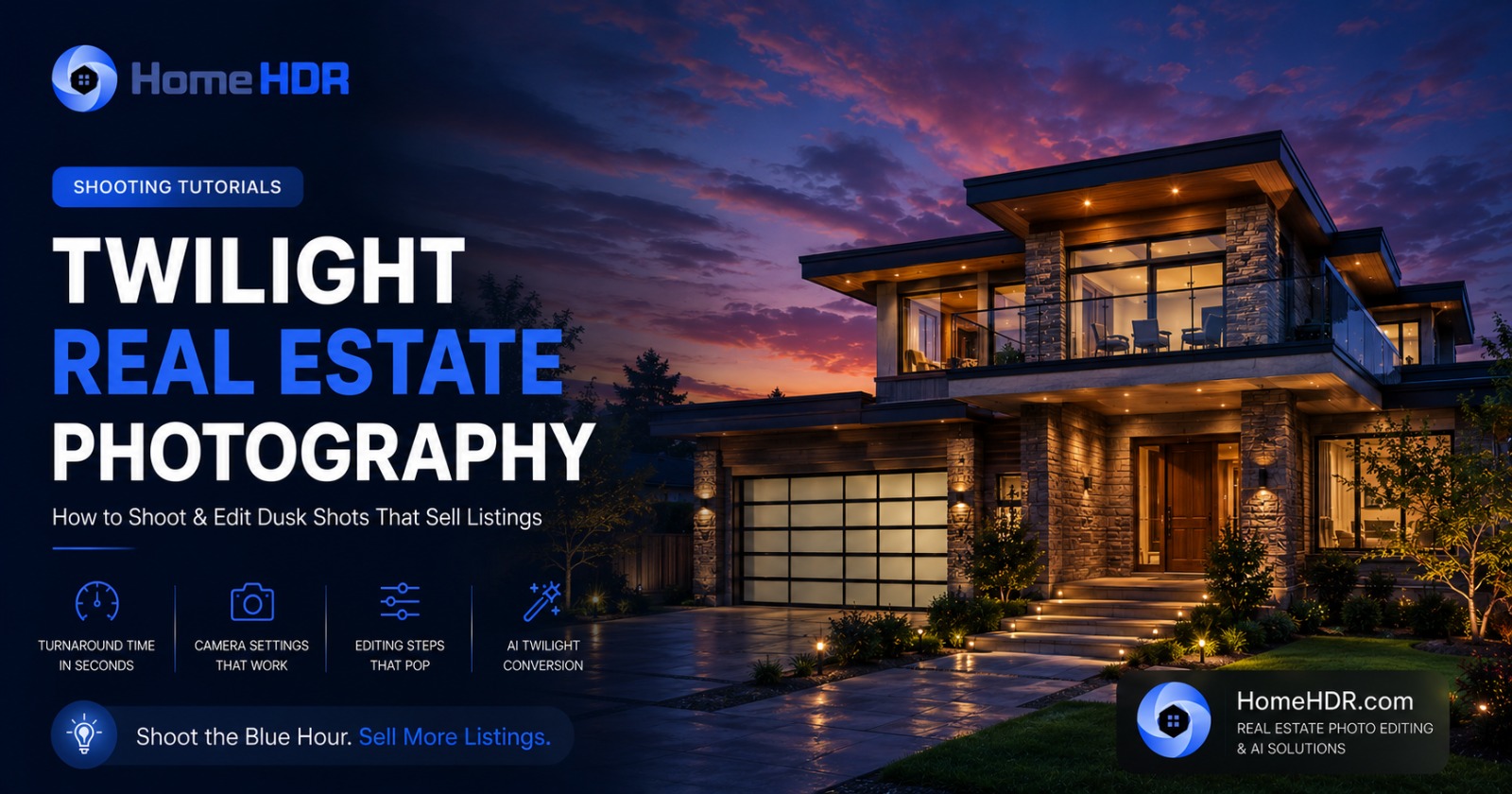
Quick answer: A twilight real estate photo is shot during the 20-40 minute window right after sunset, the "blue hour", when interior lights glow warm against a deep blue sky. It's the single highest-performing exterior shot for luxury and mid-tier listings, driving up to 68% more clicks than daytime exteriors (Redfin study). To shoot one, arrive 30 minutes before sunset, turn on every interior and landscape light, shoot on a tripod at f/8, ISO 100, RAW, and bracket 5-7 frames as the sky darkens. To skip the shoot entirely, AI twilight conversion turns a daytime exterior into a dusk shot in seconds.
Twilight shots sell listings. That's not marketing, it's what the click-through data shows. But shooting one right takes a narrow window, cold hands, and a bit of chaos. Here's how to nail it on-site, and the faster shortcut most photographers use now.
Why twilight photos sell listings
Two things drive the twilight effect:
- Warm interior lights against a cool blue sky creates a color contrast the eye is drawn to. It's the same trick cinematographers use.
- A twilight photo signals "premium listing", buyers see one, and they assume the property is worth a closer look, whether it's $400K or $4M.
The result: higher click-through on Zillow, longer time-on-listing, and more saves. Redfin reported twilight cover photos generate 68% more clicks than daytime exteriors. Even on a mid-tier listing, one twilight hero shot often outperforms every other photo in the set.
How to shoot a twilight exterior
Arrival: 30 minutes before sunset. The best light happens after the sun drops but before the sky goes fully black, the "blue hour" window, usually 20-40 minutes long. You need to be set up before it starts.
Prep the house:
- Turn on every interior light, even in rooms you're not photographing directly. The glow through side windows matters.
- Turn on all exterior/landscape lights, porch, path, uplights, pool lights, hot tub, garage.
- Open blinds and curtains on street-facing windows.
- Move cars from the driveway. Remove hoses, trash cans, kids' toys.
- If it's a pool listing, turn on pool lights, they're the money shot.
Set the camera:
- Tripod, non-negotiable. You'll be shooting 1-15 second exposures.
- Mode: Manual.
- Aperture: f/7.1-f/8 for edge-to-edge sharpness.
- ISO: 100.
- File: RAW.
- White balance: ~4000K (cools the sky, keeps the interior warmth).
- Focus: Single-point, manually set on the house before it gets dark.
- Shutter release: Remote or 2-second timer to avoid vibration.
Shoot the sequence. Fire a 5-frame bracket every 2-3 minutes starting 15 minutes before sunset. The sky changes constantly through blue hour, and you want options. The best frame is usually about 15-25 minutes after sunset, dark enough for a deep blue sky, bright enough that the house still has ambient shape.
Do not wait for the sky to go black. Once true night hits, the house looks like a floating box of light against a void, dramatic but usually not what agents want.
Camera settings for twilight (recap)
| Setting | Value |
|---|---|
| Mode | Manual |
| Aperture | f/7.1-f/8 |
| ISO | 100 |
| Shutter | 1-15 seconds (varies as light drops) |
| White balance | ~4000K, fixed |
| File | RAW |
| Bracketing | 5-7 frames, 1.5-2 stops apart |
| Support | Tripod + remote/2-sec timer |
Editing a twilight shot
The finished twilight photo is almost always a blend of multiple exposures, not a single frame. That's because no single exposure captures the deep blue sky, the warm interior windows, and the exterior detail cleanly at the same time.
The editing steps:
- Merge the brackets with HDR software (or hand-blend in Photoshop). This gives you clean shadow and highlight detail across the whole scene.
- Warm the interior windows. Use a soft brush or luminosity mask to push the window color to a warm 3000-3500K tungsten glow.
- Cool the sky. Push the sky toward a deep blue (3800-4200K, or a graduated filter).
- Bring up the exterior architecture slightly, the house should still be readable, not a silhouette.
- Enhance landscape lighting, brighten porch lights, path lights, and pool lights so they read as focal points.
- Clean up, remove any stray glare, sky noise, or utility lines.
Editing a twilight photo manually takes a skilled editor 15-30 minutes. This is why most photographers only shoot 1-2 twilight hero shots per listing.
The faster option: AI twilight conversion from a daytime photo
The workflow that's changed twilight photography in 2026: shoot the exterior in normal daylight, then convert it to twilight with AI.
The best AI twilight tools do all of the following in one pass:
- Replace the sky with a realistic dusk gradient.
- Warm the window glow.
- Add landscape lighting cast (porch, uplights, pool).
- Cool the exterior color temperature slightly.
- Match the light direction to look physically plausible.
The output isn't as controllable as a real blue-hour shoot, but for 80% of MLS listings it's indistinguishable, and it costs the photographer zero extra site time. That's the whole game: a real twilight adds 45-60 minutes on-site and a $150-$400 premium to the shoot. AI twilight is one uploaded photo and a $2-$5 add-on.
Serious rule of thumb:
- Luxury listings ($1.5M+): shoot a real twilight. The added quality is worth the shoot cost.
- Everything else: AI twilight conversion is the higher-ROI choice.
Key takeaways
- Twilight photos drive ~68% more clicks than daytime exteriors on portals like Zillow and Redfin.
- Shoot in the 20-40 minute window after sunset, turn on every interior and exterior light before it starts.
- f/8, ISO 100, ~4000K, RAW, tripod, 5-7 brackets, fire a bracket every 2-3 minutes through blue hour.
- Editing a twilight is a blend of multiple exposures: merge, warm the windows, cool the sky, boost the landscape lights.
- AI twilight conversion from a daytime shot delivers 80% of the effect for a fraction of the time and cost, the right choice on mid-tier listings.
Frequently asked questions
What time of day is best for twilight real estate photography? The 20-40 minute window right after sunset, "blue hour", is the ideal shooting range. The sky is still deep blue but not black, and interior lights read warm against it. Local sunset time varies, so check ahead.
What camera settings should I use for a twilight shot? Manual mode, f/7.1-f/8, ISO 100, RAW, tripod, remote release, fixed white balance around 4000K, and bracket 5-7 frames as the sky darkens. Shutter speed will run from about 1 to 15 seconds depending on how far into blue hour you are.
Can you make a daytime photo look like a twilight shot? Yes. AI twilight conversion tools replace the sky, warm the window glow, add landscape light cast, and cool the exterior color temperature, turning a daytime exterior into a convincing dusk shot in seconds. It's not perfect for every listing, but it's fast, cheap, and good enough for most MLS work.
Do twilight photos really help sell homes faster? Portal data (Redfin, Zillow) consistently shows twilight cover photos outperform daytime exteriors, up to 68% more clicks. Days-on-market and offer count improvements are less directly measured but strongly correlated with click-through, so the practical answer is yes.
How much should I charge for twilight real estate photography? A shot-on-site twilight typically adds $150-$400 to a listing package, depending on market and travel. AI twilight conversion is usually offered as a $10-$25 add-on per photo, or bundled into premium packages.
Shot the exterior in daylight and want a twilight version? HomeHDR converts a daytime shot into a professional dusk photo in seconds: sky, window glow, and landscape lighting handled automatically. Try 15 free edits.
By the HomeHDR Team.