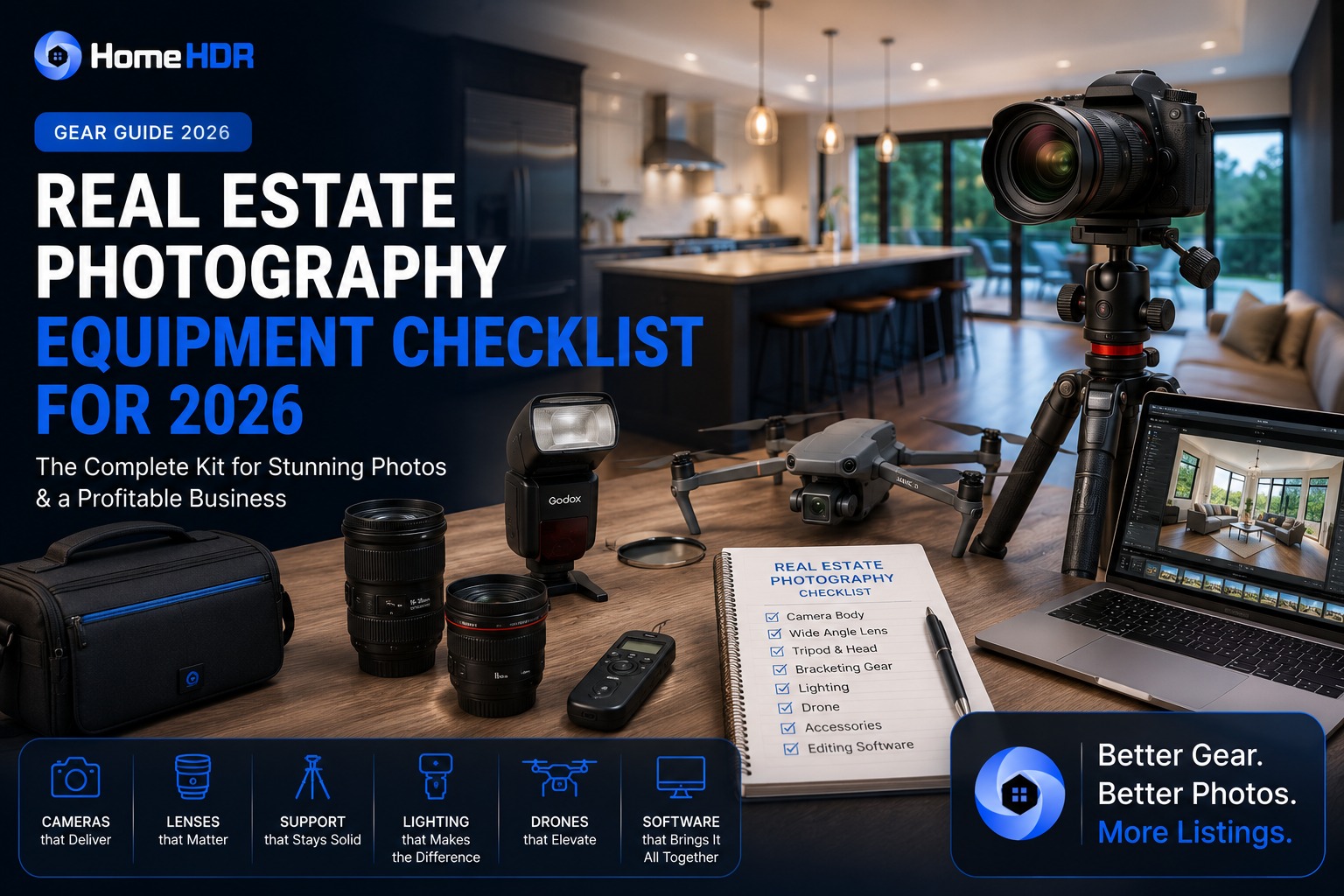
Real Estate Photography Equipment Checklist for 2026
Quick answer: A functional real estate photography kit in 2026 needs a full-frame or APS-C camera with exposure bracketing (AEB), an ultra-wide lens around 16-24 mm equivalent (f/2.8-f/4), a sturdy tripod with a leveling base, a remote shutter release, at least one speedlight, and an editing stack (Lightroom + Photoshop, or an AI editor like HomeHDR). A budget entry kit lands around $1,500, a working mid-range kit at $3,500-$5,000, and a pro kit, including a drone, at $7,500-$10,000+. Skip GPS, monitors, and gimbals until later. They don't move the needle on 90% of MLS listings.
Every dollar of gear you buy should shorten the shoot, sharpen the photo, or scale the business. Everything else is a hobby purchase. Here's the working real estate photographer's checklist for 2026, split by budget tier and by what actually matters.
Camera bodies
The single most-asked equipment question is what camera should I buy? It's the wrong first question. Any modern mirrorless or DSLR with AEB and RAW support is more than enough for MLS work.
What actually matters:
- Full-frame or APS-C sensor: both are fine. APS-C bodies are cheaper and lighter; full-frame handles high-contrast interiors slightly better.
- AEB (Auto Exposure Bracketing) with at least 5 frames, preferably 7.
- RAW file support.
- Tethered shooting or fast card offload so you can move fast on-site.
- Weather sealing if you shoot exteriors year-round.
Recommended bodies by tier:
| Tier | Body | Approx. price |
|---|---|---|
| Budget | Sony a6400, Canon EOS R10, Nikon Z fc | $800-$1,000 |
| Mid-range | Sony a7 IV, Canon R6 Mark II, Nikon Z6 III | $2,000-$2,700 |
| Pro | Sony a7R V, Canon R5 Mark II, Nikon Z8 | $3,500-$4,500 |
Do not buy a new camera every 2 years. A body from 2020 shoots the same MLS-quality photos as one from 2026. Money is better spent on lenses, lighting, and editing tools.
Lenses: the actual most important buy
More than any other piece of gear, the lens defines what your interiors look like. Cheap lens on an expensive body: bad photos. Great lens on a cheap body: professional photos.
What you need for real estate:
- Ultra-wide zoom: 16-35 mm on full-frame, or 10-20 mm on APS-C.
- Constant aperture (f/2.8 or f/4): keeps exposure predictable.
- Minimal distortion and clean corner sharpness.
Recommended lenses:
| Tier | Lens | Approx. price |
|---|---|---|
| Budget (APS-C) | Sigma 10-18mm f/2.8, Tokina 11-20mm f/2.8 | $500-$650 |
| Mid-range (full-frame) | Tamron 17-28mm f/2.8, Sigma 16-28mm f/2.8 | $700-$900 |
| Pro (full-frame) | Sony 16-35mm f/2.8 GM II, Canon RF 15-35mm f/2.8L, Nikon Z 14-24mm f/2.8 S | $2,000-$2,500 |
A note on focal length. Ultra-wide is essential for tight rooms, but shooting too wide (below 14mm equivalent) distorts the room and gives the "fisheye" real estate look that agents and buyers hate. Stay in the 16-24mm equivalent range for most shots.
A note on tilt-shift. Tilt-shift lenses (Canon TS-E 17mm, Nikon PC-E 19mm) give perfectly straight verticals with no editing. They cost $2,000-$3,500 and are luxury-tier only. Modern lens-correction software achieves 95% of the same result at 0% of the price.
Tripod, head, and support
Non-negotiable. Real estate photography without a tripod is real estate photography with worse photos and slower editing.
What you need:
- Aluminum or carbon-fiber tripod rated for at least twice your camera + lens weight.
- Center column that goes up to ~65 inches (typical human eye level).
- Ball head or geared head with quick-release plate.
- Leveling base or built-in bubble level so you don't have to level in editing.
Recommendations:
| Tier | Tripod | Approx. price |
|---|---|---|
| Budget | Manfrotto Element MII, Neewer Carbon Fiber | $150-$250 |
| Mid-range | Manfrotto 190XPRO, Peak Design Travel Tripod | $350-$500 |
| Pro | Really Right Stuff TVC-24L + BH-40 head | $1,200-$1,600 |
Skip: cheap sub-$100 tripods. They sag, drift, and vibrate, which ruins bracket alignment. A wobbly tripod is worse than no tripod at all.
Bracketing gear: the small stuff that saves shoots
- Remote shutter release (cable or Bluetooth). Prevents vibration on long exposures. $20-$60.
- Extra batteries: you'll burn 2-3 per busy shoot day. $30-$80 each.
- Two 64GB or 128GB SD/CFexpress cards. Redundant recording if your camera supports dual slots. $50-$150 each.
- Card reader for fast offload. USB-C, UHS-II. $30-$80.
- Lens cloth + air blower + rocket blower. House dust is your enemy. $15.
Lighting
You can shoot 100% ambient HDR and get professional MLS photos, and that's the point of the whole HDR technique. But one speedlight unlocks flambient shooting and cleans up mixed-color lighting in ways HDR alone can't.
Minimum lighting kit:
- 1 speedlight: Godox V860III, Godox V1, or your brand's OEM equivalent. $180-$300.
- Off-camera trigger if your speedlight isn't wireless-capable natively. $50-$80.
- Bounce card or small softbox for softening flash on ceilings. $20-$40.
Upgrade path (once you're shooting 5+ listings/week):
- Second speedlight for multi-flash flambient. $180-$300.
- Video LED panel (Aputure MC or MC Pro) for continuous fill light. $90-$220.
- Battery-powered strobe (Godox AD200Pro) for high-power exterior fill. $350.
Skip: studio strobes, giant softboxes, umbrella kits. Real estate photography is location-based; anything you can't fit in one bag is more setup than it's worth.
Drone for exteriors
Not required, but it separates listings that look professional from listings that look great. Every luxury and mid-tier ($700K+) listing benefits from at least one aerial establishing shot.
Recommended drones:
| Tier | Drone | Approx. price |
|---|---|---|
| Budget | DJI Mini 4 Pro | $760 |
| Mid-range | DJI Air 3S | $1,100-$1,400 |
| Pro | DJI Mavic 4 Pro | $2,300-$2,900 |
Legal note. In the US, commercial drone use requires an FAA Part 107 license ($175 exam fee, ~15 hours of study). In Canada, an Advanced RPAS certificate. Both are required before you charge for drone photos. Fly unlicensed for money and you're one insurance claim away from a serious problem.
Software and editing stack
Gear is meaningless if your editing pipeline is slow. This is where most photographers under-invest.
Editing essentials:
- Lightroom Classic: cataloging, RAW processing, batch color. $10/month with Photoshop.
- Photoshop: object removal, virtual staging, precise sky work.
- AI HDR / editing tool: HomeHDR, Autoenhance.ai, AutoHDR, or Aurora HDR for automated merges. $10-$100/month or per-image pricing.
- Cloud backup: Backblaze, Dropbox, or Google Drive. Assume every hard drive fails eventually. $7-$25/month.
Optional but useful:
- Capture One if you prefer its color engine over Lightroom. $180/year.
- Topaz Photo AI for sharpening and noise reduction. $200 one-time.
- Enscape or Matterport 3D tours if you offer virtual tours as an add-on. $50-$200/month.
Editing software will save more time than any camera upgrade. If you're stuck choosing between a new lens and an AI editor subscription, take the editor.
Total budget by tier
| Tier | What you get | Total |
|---|---|---|
| Budget | APS-C mirrorless + ultra-wide zoom + solid tripod + 1 speedlight + editing stack | ~$1,500-$1,800 |
| Working pro | Full-frame + f/2.8 wide zoom + carbon tripod + 2 speedlights + drone + editing stack | ~$3,500-$5,000 |
| High-end pro | Top-tier full-frame + G/L-series wide + RRS tripod + 3+ speedlights + Mavic 4 Pro + editing stack + backup body | ~$7,500-$10,000+ |
You do not need the high-end kit to charge $250-$400 per listing. Plenty of six-figure real estate photographers work full-time on the working-pro kit. Buy up only when income justifies the tool.
What to skip
- GPS units for geotagging photos. Nice to have; not selling more listings.
- External monitors for shoots. Adds bulk, small ROI.
- Full lighting kits with softboxes, C-stands, and umbrellas.
- Gimbals unless you're offering video walkthroughs.
- Camera bags over $200. The cheap ones work.
- New camera bodies every generation. Every 4-6 years is fine.
Key takeaways
- The lens matters more than the camera body. Prioritize a good 16-24mm-equivalent ultra-wide.
- Tripod is non-negotiable. Don't cheap out under $150.
- One speedlight unlocks flambient shooting. Two is the upgrade.
- Drone requires Part 107 in the US, Advanced RPAS in Canada, before commercial use.
- AI editing software is the single highest-ROI purchase in the stack. It turns 3-hour edits into 20-minute deliveries.
Frequently asked questions
What is the best camera for real estate photography in 2026? Any full-frame or APS-C mirrorless with AEB and RAW support works. Solid choices: Sony a7 IV, Canon R6 Mark II, Nikon Z6 III (mid-range), or Sony a6400, Canon R10 (budget). Don't overspend. The lens matters more than the body.
What is the best wide-angle lens for real estate photography? On full-frame, look at 16-35mm f/2.8 zooms: Sony 16-35 GM II, Canon RF 15-35L, or Tamron 17-28 f/2.8 for a cheaper option. On APS-C, the Sigma 10-18mm f/2.8 or Tokina 11-20mm f/2.8. Stay in the 16-24mm equivalent range to avoid distortion.
Do I need a full-frame camera for real estate photography? No. APS-C bodies produce professional MLS-ready photos when paired with a good ultra-wide lens. Full-frame gives slightly better dynamic range for high-contrast interiors, but it's a marginal difference, not a must-have.
How much does a starter real estate photography kit cost in 2026? A functional budget kit (APS-C mirrorless, ultra-wide lens, tripod, speedlight, editing stack) runs about $1,500-$1,800. A working-pro setup with full-frame, drone, and multiple flashes is $3,500-$5,000.
Do I need a drone for real estate photography? Not to start. A drone becomes valuable on listings above ~$700K, on properties with acreage or waterfront, and for luxury work. In the US, commercial drone use requires an FAA Part 107 license before you can charge for aerial photos.
Buying the wrong lens is expensive. Buying an AI editor that shaves hours off every shoot pays for itself in a week. HomeHDR turns your brackets into MLS-ready photos in minutes from $0.10 each. Try 15 free edits.
By the HomeHDR Team.